Semiconductor ETF Comparison: SMH vs SOXX vs XSD – AI Boom Meets ROI Reality Check
Looking for the best semiconductor ETF comparison as AI spending hits record highs but returns disappoint? The semiconductor sector faces an unprecedented paradox in 2026: hyperscalers are pouring $600 billion into AI infrastructure while struggling to prove meaningful ROI, raising questions about whether chip demand is sustainable or a bubble waiting to burst. (We previously analyzed tech ETFs including QQQ, VGT, and XLK – see our complete tech ETF comparison guide.)
This semiconductor ETF comparison breaks down SMH vs SOXX vs XSD with current market data, AI profitability concerns, and which ETF survives if the AI spending spree slows down.
The Quick Answer (If You’re Busy)
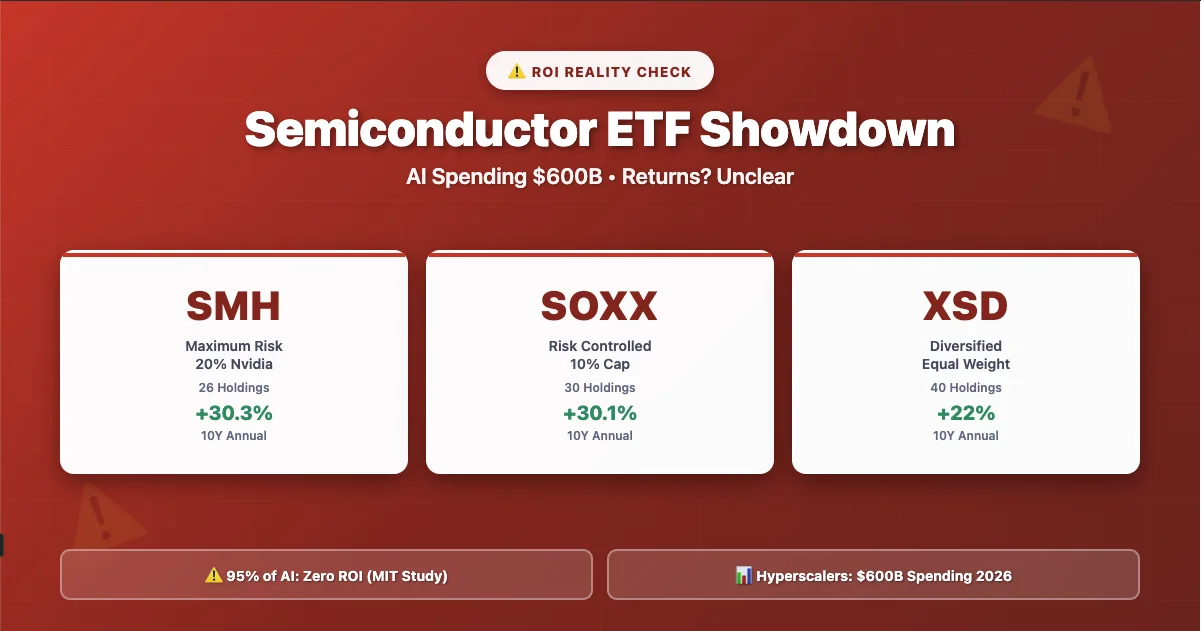
For maximum chip leader exposure: SMH gives you 20%+ Nvidia concentration with highest historical returns (30.3% annually) but extreme volatility if AI spending reverses.
For balanced risk-return: SOXX caps individual holdings at 10% and delivers nearly identical long-term performance (30.1% annually) with built-in downside protection.
For diversified small-cap upside: XSD’s equal-weight approach spreads risk across 40 stocks, underperforming during mega-cap rallies but offering protection if investor sentiment shifts from giants to smaller chip designers.
Current market reality: All three semiconductor ETFs are navigating record chip demand (2026 industry revenue: $1 trillion) against mounting evidence that AI investments aren’t delivering expected returns—a tension that could determine which ETF strategy wins over the next 12-24 months.
Still here? Let’s dive into why 2026 might be the most critical year in semiconductor investing history.
The AI ROI Problem Nobody Talks About
February 2026 finds semiconductor investors at an uncomfortable crossroads. On one side: record-breaking chip demand driven by AI infrastructure buildout. On the other: mounting evidence that companies spending billions on AI aren’t seeing commensurate returns.
The Numbers Tell a Troubling Story
AI Infrastructure Spending (2026 Projected):
- Microsoft: $80 billion capex
- Meta: $65 billion capex
- Google: $75 billion capex
- Amazon: $85 billion capex
- Combined: $550-600 billion in 2026 alone
These four hyperscalers are the semiconductor industry’s primary customers. Nvidia, AMD, Broadcom, and TSMC depend on this spending continuing—or accelerating—to justify current valuations.
But Here’s the Problem:
A 2026 MIT study found that 95% of enterprises report zero or negative ROI from AI investments. Companies are spending billions to deploy AI systems that aren’t yet delivering measurable business value.
Goldman Sachs published a June 2024 report asking bluntly: “AI: Too Much Spend, Too Little Benefit?” The conclusion: most AI applications don’t solve problems cost-effectively enough to justify the infrastructure investment.
The Circular Financing Concern
The Wall Street Journal reported in 2024 that Nvidia’s revenue model includes a troubling pattern: Nvidia invests in AI startups → those startups use Nvidia’s investment to buy Nvidia chips → Nvidia reports the chip sales as revenue.
This creates “circular revenue” that inflates demand signals. If Nvidia’s investment pace slows, does chip demand hold up? Or was some portion of the demand artificial?
Similar concerns exist with hyperscalers:
- Microsoft invests $13 billion in OpenAI
- OpenAI uses that capital to buy Microsoft Azure compute (Nvidia chips)
- Microsoft reports Azure growth
- But is this sustainable demand or financial engineering?
Why This Matters for Semiconductor ETFs
If AI ROI concerns cause spending to plateau or decline, the semiconductor sector faces a demand cliff. The difference between SMH, SOXX, and XSD becomes critical:
SMH (concentrated in Nvidia/TSMC): Maximum exposure to AI infrastructure leaders = maximum upside if spending continues, maximum downside if it doesn’t.
SOXX (capped at 10% per holding): Moderate exposure with built-in risk limits = balanced outcome either way.
XSD (equal-weighted across 40 stocks): Diversified beyond AI infrastructure = less sensitive to hyperscaler spending decisions.
Semiconductor ETF Comparison: SMH vs SOXX vs XSD
SMH (VanEck Semiconductor ETF)
What it tracks: MVIS US Listed Semiconductor 25 Index
Number of holdings: 26 companies
Expense ratio: 0.35%
Assets under management: ~$27 billion
Top 10 concentration: 72-76% of assets
Inception: May 5, 2000
The reality: SMH is the purest bet on AI infrastructure dominance continuing. With Nvidia representing nearly 20% and TSMC another 15%, this ETF rises and falls with the belief that current AI spending levels are sustainable.
Top Holdings (February 2026):
- Nvidia: ~20%
- TSMC: ~15%
- Broadcom: ~8%
- ASML: ~7%
- AMD: ~6%
AI exposure: ~70% of holdings are directly tied to data center AI infrastructure.
SOXX (iShares Semiconductor ETF)
What it tracks: NYSE Semiconductor Index
Number of holdings: 30 companies
Expense ratio: 0.35%
Assets under management: ~$17 billion
Top 10 concentration: ~62% of assets
Inception: July 10, 2001
The reality: SOXX uses modified market-cap weighting capped at 10% per holding. This limits single-stock risk if Nvidia stumbles but maintains substantial exposure to the AI infrastructure theme.
Top Holdings (February 2026):
- Nvidia: ~10% (capped)
- Broadcom: ~10% (capped)
- TSMC: ~9%
- AMD: ~8%
- ASML: ~7%
AI exposure: ~60% AI infrastructure, more balanced toward other semiconductor segments.
XSD (SPDR S&P Semiconductor ETF)
What it tracks: S&P Semiconductor Select Industry Index
Number of holdings: 40 companies
Expense ratio: 0.35%
Assets under management: ~$1.7 billion
Top 10 concentration: ~30% of assets
Inception: January 31, 2006
The reality: XSD’s equal-weight methodology means Nvidia gets the same ~2.5% allocation as small-cap chip designers. This underperforms when mega-caps dominate but provides downside protection if the market rotates to smaller players.
Equal-weight approach:
- Each of 40 holdings: ~2.5%
- Quarterly rebalancing
- Includes analog chips, memory, fabless designers
- Less dependent on hyperscaler AI spending
AI exposure: ~35-40% AI infrastructure, majority in other semiconductor segments.
Performance That Actually Matters
Semiconductors were among the top-performing ETF sectors in 2025.
2026 YTD Performance (as of February 12)
Returns:
- SOXX: +14.94%
- SMH: ~+13-14%
- XSD: ~+5-7%
What this tells us: 2026 started strong for AI-heavy ETFs despite ROI concerns. Investors are betting that spending continues regardless of profitability. XSD’s underperformance reflects ongoing preference for proven mega-caps.
Long-Term Performance Reality
10-Year Annualized Returns:
- SMH: +30.3%
- SOXX: +30.07%
- XSD: ~+22-25%
The critical insight: Over a full market cycle, SMH and SOXX perform virtually identically. SMH’s extra concentration doesn’t deliver meaningfully higher returns—just higher volatility.
1-Year Performance (February 2025-2026):
- SOXX: +59.70%
- SMH: ~+55-60%
- XSD: ~+45-50%
3-Year Annualized:
- SOXX: +38.03%
- SMH: ~+35-38%
- XSD: ~+28-32%
Volatility & Risk: What You’re Actually Signing Up For
Standard Deviation (annualized volatility):
- SMH: ~26%
- SOXX: ~24-25%
- XSD: ~24%
Beta (vs S&P 500):
- SMH: ~1.5 (moves 50% more than market)
- SOXX: ~1.4
- XSD: ~1.3
Maximum Drawdown (2022 bear market):
- SMH: -54.6%
- SOXX: -45.8%
- XSD: -48.2%
Translation: If AI ROI concerns trigger a semiconductor selloff, expect:
- SMH to fall ~55%
- SOXX to fall ~45%
- XSD to fall ~48%
The question: Does SMH’s extra 9% downside risk justify essentially identical long-term returns?
The Bull Case: Why AI Spending Continues Despite ROI Concerns
Before declaring the AI boom over, consider the structural arguments for continued chip demand:
1. AI is Early—ROI Takes Time
Internet companies weren’t profitable in 1999 either. Amazon lost money for years. The lack of immediate ROI doesn’t mean AI won’t eventually transform industries.
Counterargument: Dot-com bubble companies that never found profitability went to zero. How do we know AI is Amazon and not Pets.com?
2. Hyperscalers Can’t Stop Spending
Microsoft, Google, Amazon, and Meta are in an arms race. If Microsoft slows AI investment, Google gains competitive advantage. This creates a prisoner’s dilemma forcing continued spending.
Counterargument: The prisoner’s dilemma breaks when shareholders demand profitability. If one company proves AI spending doesn’t drive returns, others must follow or face investor revolt.
3. Data Center Demand Beyond AI
Cloud computing, streaming, autonomous vehicles, and traditional data center workloads still require chips. AI infrastructure is additive, not the entire story.
Counterargument: AI is 60-70% of current data center chip demand. If that category stalls, overall semiconductor growth slows dramatically.
4. AI Becomes More Efficient = More Usage
The Jevons Paradox: As technology becomes more efficient and cheaper, usage explodes. Efficient AI drives more AI deployment, not less chip demand.
Counterargument: This only works if AI creates value. Infinite usage of unprofitable technology still equals zero revenue.
The Bear Case: Why This Ends Badly
1. Goldman Sachs Warning: “Too Much Spend, Too Little Benefit”
The investment bank’s 2024 report highlighted that generative AI requires $1 trillion in infrastructure spending but hasn’t yet found a “killer app” justifying that cost.
The math doesn’t work: To justify $1 trillion in capex, AI needs to replace tasks worth trillions in labor costs. Current use cases (writing emails, generating images) don’t reach that threshold.
2. Michael Burry’s Bubble Call
The investor who predicted the 2008 financial crisis called AI “the largest bubble of all time” in 2024. His argument: valuations assume perpetual exponential growth that’s mathematically impossible.
Nvidia’s forward P/E: ~40x
Historical semiconductor average: ~18-22x
Implication: Nvidia stock already prices in years of perfect execution.
3. MIT Study: 95% Zero ROI
When enterprises were surveyed about AI implementation results:
- 5% reported positive ROI
- 40% reported zero ROI
- 55% reported negative ROI
If 95% of AI spending delivers no value, how long before CFOs cut budgets?
4. Circular Financing Can’t Last
Nvidia investing in startups that buy Nvidia chips creates artificial demand. This works in a bull market but unravels when:
- Nvidia’s stock falls (less capital to invest)
- Startups burn through cash without finding revenue models
- Investors demand actual customers, not circular transactions
5. Historical Precedent: Every Infrastructure Boom Overshoots
- 1990s: Fiber optic cable overbuilding
- 2000s: Data center overcapacity
- 2010s: Solar panel manufacturing glut
Infrastructure buildouts always overshoot demand because:
- Companies fear being left behind
- Wall Street rewards growth over profitability
- Nobody wants to be the first to slow down
SMH vs SOXX vs XSD: Which Survives Each Scenario?
Scenario A: AI Spending Continues (Bull Case Correct)
Winner: SMH
Maximum Nvidia/TSMC exposure captures full upside of continued hyperscaler demand.
Runner-up: SOXX
Nearly identical returns with slightly less concentration risk.
Laggard: XSD
Equal-weighting underperforms when mega-caps dominate.
Probability: 40%
Based on: Hyperscaler arms race dynamics, early-stage AI adoption, historical tech boom patterns.
Scenario B: AI Spending Plateaus (Moderate Case)
Winner: SOXX
10% caps prevent catastrophic single-stock losses if Nvidia/AMD growth slows. Exposure to non-AI semiconductor segments (automotive, industrial, consumer) provides stability.
Runner-up: XSD
Equal-weighting benefits from sector rotation to smaller, overlooked chip companies with stable businesses.
Laggard: SMH
20% Nvidia concentration becomes liability if AI chip demand growth decelerates.
Probability: 40%
Based on: Current lack of AI ROI, slowing enterprise adoption curves, regulatory uncertainties.
Scenario C: AI Bubble Bursts (Bear Case Correct)
Winner: XSD
Equal-weighting and small-cap exposure provide diversification away from overvalued AI infrastructure giants. Analog chip makers, memory companies, and automotive semiconductor firms maintain stable demand.
Runner-up: SOXX
10% caps limit damage from Nvidia/AMD declines. Broader holdings cushion the fall.
Loser: SMH
20% Nvidia + 15% TSMC = 35% exposure to companies whose valuations depend entirely on AI infrastructure spending continuing. If that reversal happens, SMH falls hardest and fastest.
Probability: 20%
Based on: Historical bubble patterns, extreme valuations, lack of proven AI ROI.
The Verdict: Here’s What I’d Actually Do
If I had to pick one: SOXX.
Why? It offers the best risk-adjusted profile across all three scenarios:
- Bull case: Nearly identical returns to SMH (30.07% vs 30.3% over 10 years)
- Moderate case: Outperforms SMH due to concentration caps
- Bear case: Outperforms SMH, though trails XSD
SOXX is the only ETF that doesn’t suffer catastrophic underperformance in any scenario.
Portfolio Strategy by Risk Tolerance
Conservative (Can’t Stomach 50%+ Drawdowns):
- 70% SOXX
- 30% XSD
- Rationale: SOXX for core exposure, XSD for small-cap diversification
Moderate (Accept Volatility for Growth):
- 80% SOXX
- 20% SMH
- Rationale: SOXX foundation with SMH position for extra AI upside
Aggressive (Betting AI Spending Continues):
- 60% SMH
- 40% SOXX
- Rationale: Maximum Nvidia/TSMC exposure with SOXX safety net
What I’d Avoid
Don’t do this:
- 100% SMH = excessive concentration risk
- 100% XSD = guaranteed underperformance in current market
- Leveraged semiconductor ETFs (SOXL) = volatility decay destroys value
Cost Comparison: All Charge 0.35%, But…
Expense Ratios:
- SMH: 0.35%
- SOXX: 0.35%
- XSD: 0.35%
The fees are identical. Real cost differences come from:
Liquidity (Bid-Ask Spreads):
- SMH: ~$0.01 (tightest)
- SOXX: ~$0.01 (tight)
- XSD: ~$0.02-0.03 (wider due to lower volume)
Hidden Cost—Volatility:
SMH’s extra volatility creates psychological costs:
- More likely to panic sell during drawdowns
- Higher intraday swings trigger emotional decisions
- Concentration anxiety during Nvidia earnings
SOXX’s lower volatility = easier to hold long-term = better compound returns for most investors.
Even small expense ratio differences compound over decades – see our expense ratio analysis for the math.
What Smart Money is Saying
Ray Dalio (Bridgewater Associates):
“Very similar to the dot-com bubble. Everybody is excited about AI but can’t explain how it makes money.”
Jamie Dimon (JP Morgan CEO):
“AI is real, but some of the money being invested now will prove to be wasted.”
Warren Buffett (Berkshire Hathaway):
Berkshire holds zero semiconductor stocks. Buffett avoids industries he doesn’t understand—and admits he doesn’t understand how semiconductor valuations are justified.
David Einhorn (Greenlight Capital):
Shorting “AI bubble stocks” as of Q4 2024. Believes current valuations assume impossible growth rates.
But also…
Morgan Stanley:
“Growth visibility remains strong through 2027. Data center buildouts are multi-year cycles.”
Goldman Sachs (different team than the skeptics):
“Rapid appreciation substantiated by robust profit growth, not speculation.”
Wall Street is split. Choose your semiconductor ETF based on which argument you find more convincing.
The Hidden Risk All Three ETFs Share
When analyzing SMH vs SOXX vs XSD, investors focus on concentration differences. But all three share one critical vulnerability:
Sector correlation.
During market stress, the entire semiconductor sector moves together:
- 2022 bear market: All three fell 45-55%
- 2020 COVID crash: All three fell 35-40%
- When semiconductors sell off, ETF structure doesn’t matter much
Your choice between SMH, SOXX, and XSD determines:
- How much you lose in a downturn
- Which scenario you’re positioned for
But none provide true diversification away from semiconductor sector risk.
2026 Outlook: Key Events to Watch
Q1-Q2 2026 Catalysts:
Earnings Season (February-April):
- Nvidia/AMD report data center revenue trends
- If growth decelerates, bubble concerns intensify
- If growth accelerates, validates current valuations
Hyperscaler Capex Guidance:
- Microsoft/Google/Meta/Amazon report 2026 spending plans
- Any reduction triggers sector-wide selloff
- Increases justify current chip stock valuations
AI ROI Evidence:
- Do enterprises show measurable AI-driven revenue growth?
- Or do CFOs start cutting AI budgets?
Semiconductor Equipment Orders:
- ASML/Applied Materials order trends = leading indicator
- Declining orders signal coming demand slowdown
Potential Positive Surprises:
- AI “killer app” emerges (like iPhone moment for mobile)
- Autonomous vehicles scale (new chip demand source)
- Quantum computing reaches commercialization
Potential Negative Surprises:
- Major AI company admits project failure
- Hyperscaler announces capex cut
- Recession reduces corporate tech spending
- China develops domestic chip manufacturing (reduces TSMC/ASML demand)
Practical Decision Framework
Choose SMH if: ✅ You believe AI spending continues for 5+ years
✅ You can stomach 50%+ drawdowns
✅ You want maximum exposure to Nvidia/TSMC
✅ You’re growth-focused with long time horizon
✅ You’re comfortable with high concentration risk
Choose SOXX if: ✅ You want semiconductor exposure with risk controls
✅ You value sleep-at-night portfolio construction
✅ You believe AI grows but at uncertain pace
✅ You want similar returns to SMH with lower volatility
✅ You’re positioning for multiple scenarios
Choose XSD if: ✅ You think mega-cap semiconductors are overvalued
✅ You want exposure beyond AI infrastructure
✅ You’re contrarian and betting on sector rotation
✅ You’re diversifying away from tech concentration
✅ You believe small-caps will eventually outperform
Final Thoughts: The Most Important Question
The semiconductor sector in 2026 isn’t about which ETF is “best.” It’s about answering one question:
Do you believe current AI infrastructure spending is sustainable?
If yes → SMH or SOXX (slight preference for SOXX’s risk controls)
If no → XSD or reduce semiconductor exposure entirely
If unsure → SOXX splits the difference
The truth: Nobody knows whether 2026’s AI spending represents the beginning of a transformative technology cycle or the peak of an unsustainable bubble.
What we do know:
- Hyperscalers are spending $550-600 billion in 2026
- Most enterprises report zero AI ROI
- Semiconductor stocks trade at 2x historical valuations
- The sector’s success depends entirely on spending continuing
This is the most uncertain moment in semiconductor investing history.
Choose the ETF that aligns with your conviction level—and your ability to withstand being wrong.
Whether you choose SMH, SOXX, or XSD, the critical decision is position sizing. If semiconductors are 20%+ of your portfolio, you’re making a concentrated bet on AI infrastructure demand continuing. If that bet is wrong, no ETF structure saves you.
But if you’re right? The next decade could deliver returns that make 2010-2020’s performance look modest.
The semiconductor ETF you choose matters less than the conviction and risk management with which you hold it.
⚠️ Disclaimer: I am not a licensed financial advisor. Content here is for educational purposes only and should not be considered personalized investment advice. Always do your own research before making investment decisions.