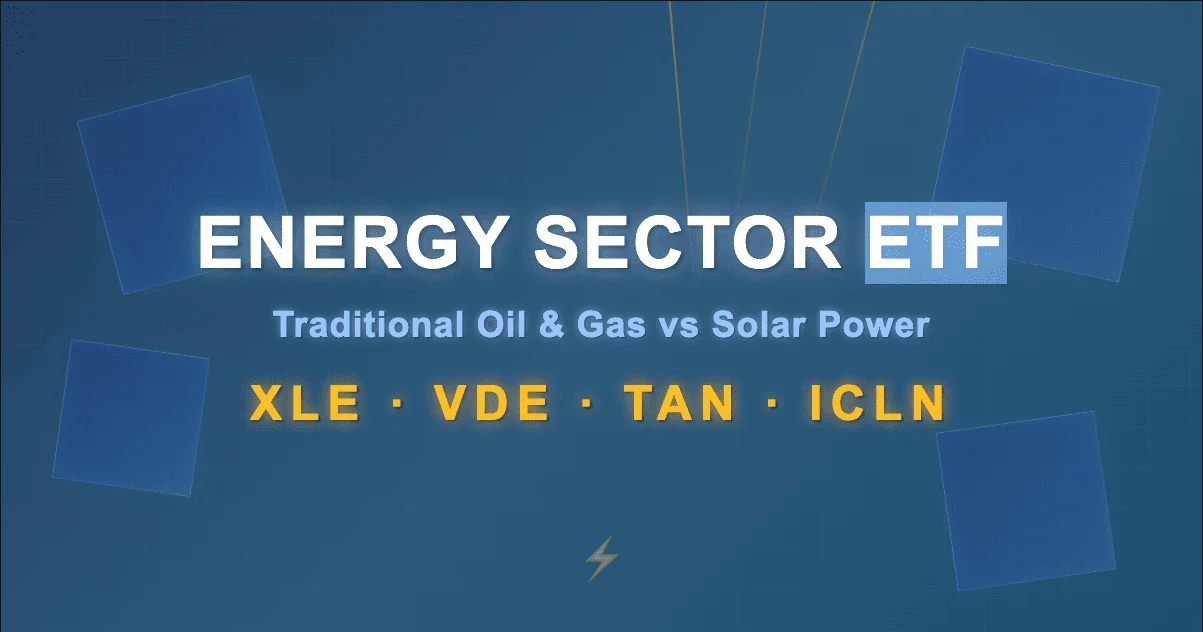
Complete Guide to Energy Sector ETFs: From Traditional Energy to Solar Power
📊 Why Should You Pay Attention to the Energy Sector in 2026?
The energy sector stands at a critical crossroads in early 2026. While traditional energy has posted solid gains driven by geopolitical events (particularly the Venezuelan regime change in January 2026), the renewable energy sector faces a dramatically altered policy landscape following the passage of the One Big Beautiful Bill Act (OBBBA) in July 2025.
The OBBBA fundamentally reshaped clean energy economics by:
- Eliminating Section 45Y and 48E tax credits for projects starting construction after July 4, 2026
- Ending Section 25D residential solar tax credits after December 2025
- Introducing new Foreign Entity of Concern (FEOC) restrictions targeting Chinese supply chains
Despite policy headwinds, renewable energy continues to dominate new capacity additions, accounting for 93% of U.S. power capacity growth through September 2025 (30.2 gigawatts), with solar and storage representing 83% of that total.
The Two Faces of the Energy Sector
Traditional Energy (Oil/Gas)
- Recent Performance: XLE up 21.56% over past year (as of Feb 2026)
- Strong oil price support from OPEC+ production discipline
- Venezuela situation creating supply concerns
- Benefiting from AI data center power demand
- Dividend yields around 3%
Renewable Energy (Solar/Wind)
- Recent Performance: ICLN up 70% over past year; TAN up 72%
- Policy uncertainty creating safe-harbor project rush
- AI data center electricity demand driving unprecedented growth
- Bloom Energy’s 435% surge highlighting sector winners
- High volatility but massive upside potential
🏆 Comparing Major Traditional Energy ETFs
1. XLE (Energy Select Sector SPDR Fund)
Basic Information (February 2026)
- Provider: State Street
- Assets Under Management: $36.1 billion
- Expense Ratio: 0.08% (down from 0.10%)
- Current Price: $53.96
- Dividend Yield: ~3.12%
- 1-Year Return: +21.56%
Key Features
- Tracks S&P 500 energy sector companies
- Dominated by oil & gas supermajors
- Exceptional liquidity with penny-wide spreads
- Perfect for tactical energy exposure
Top 5 Holdings (February 2026)
- Exxon Mobil (XOM) – 24.40%
- Chevron (CVX) – 17.90%
- ConocoPhillips (COP) – 6.88%
- SLB N.V. (SLB) – 4.51%
- The Williams Companies (WMB) – 4.49%
Performance Context XLE outperformed crude oil significantly in 2025, gaining 7.8% despite oil prices dropping 20%. This demonstrates the portfolio’s operational resilience and dividend strength.
✅ Advantages
- Ultra-low expense ratio (0.08%)
- Highest liquidity among energy ETFs
- Stable cash flows from integrated majors
- Inflation hedge characteristics
⚠️ Disadvantages
- Extreme concentration: Top 2 holdings = 42%
- Limited exposure to energy transition themes
- Vulnerable to oil price volatility
- No pure renewable energy exposure
2. VDE (Vanguard Energy ETF)
Basic Information (February 2026)
- Provider: Vanguard
- Assets Under Management: $8.64 billion
- Expense Ratio: 0.09%
- Dividend Yield: ~3.5%
- 1-Year Return: Similar to XLE
Key Features
- Tracks MSCI US Investable Market Energy Index
- Broader holdings base (~120 companies vs XLE’s ~21)
- Includes meaningful small/mid-cap exposure
- True sector diversification
XLE vs VDE: 2026 Comparison
| Feature | XLE | VDE |
|---|---|---|
| Number of Holdings | ~21 | ~120 |
| Top 10 Concentration | Very High (65%+) | High (~50%) |
| Expense Ratio | 0.08% | 0.09% |
| AUM | $36.1B | $8.64B |
| Liquidity | Exceptional | Very Good |
| Small/Mid-Cap Exposure | Minimal | Moderate |
| Best For | Tactical trades | Diversified sector bet |
3. IXC (iShares Global Energy ETF)
Basic Information
- Provider: BlackRock
- Assets Under Management: ~$1.5 billion
- Expense Ratio: 0.43%
- Dividend Yield: ~3.8%
Key Features
- Global energy exposure (~40% non-US)
- Access to international oil majors (BP, Shell, TotalEnergies, etc.)
- Currency diversification benefit
- Geopolitical risk spreading
Pros and Cons of Global Exposure
✅ Advantages:
- Geographic diversification reduces country-specific risks
- Access to emerging market energy growth
- Exposure to national oil companies with strategic positioning
⚠️ Disadvantages:
- Higher expense ratio (0.43% vs 0.08-0.09%)
- Lower liquidity than domestic alternatives
- Foreign withholding taxes on dividends
- Additional currency risk
🌞 Solar-Focused Renewable Energy ETFs: Navigating the 2026 Reality
The Solar Sector After OBBBA
Current State (February 2026):
- Solar ETFs rebounded strongly in 2025 despite policy changes
- Developers rushing to start construction before July 4, 2026 deadline
- ~50 GW of projects positioned to begin construction before year-end 2026
- ~40 GW more targeted for H1 2026 start
- AI data center power demand providing fundamental support
Key Policy Timeline:
- Now – July 4, 2026: Window to start construction and qualify for tax credits
- After July 4, 2026: No more Section 45Y/48E tax credits for new projects
- 4-year completion window: Projects started by deadline have 4 years to come online
1. TAN (Invesco Solar ETF)
Basic Information (February 2026)
- Provider: Invesco
- Assets Under Management: $1.61 billion
- Expense Ratio: 0.70%
- Current Price: $57.92
- Dividend Yield: ~0.5%
- 1-Year Return: +71.56%
Key Features
- Tracks MAC Global Solar Energy Index
- Pure-play solar exposure across entire value chain
- 42 total holdings (up from ~35 previously)
- Highly concentrated: Top 10 = 59.51%
Top 10 Holdings (February 2026)
- Nextpower Inc. (NXT) – 11.32%
- Enphase Energy (ENPH) – 7.62%
- First Solar (FSLR) – 7.32%
- Enlight Renewable Energy (ENLT.TA) – 6.38%
- Sunrun (RUN) – 5.93%
- GCL Technology Holdings (3800.HK) – 5.14%
- HA Sustainable Infrastructure Capital (HASI) – 3.97%
- Xinyi Solar Holdings (0968.HK) – 3.91%
- SolarEdge Technologies (SEDG) – 3.78%
- Solaria Energía (SLR.MC) – 3.44%
Geographic Distribution
- United States: ~45%
- China/Hong Kong: ~20% (reduced from 30% due to FEOC concerns)
- Israel: ~11% (Enlight, others)
- Europe: ~15%
- Others: ~9%
Sector Breakdown by Value Chain
- Technology (Equipment/Systems): 69.52%
- Utilities (Power Generation): 23.90%
- Financial Services (Infrastructure Capital): 3.99%
- Industrials: 2.59%
Performance Drivers (Past Year) The 72% return was NOT evenly distributed:
- Winners: Nextpower up significantly, Enphase recovered
- Laggards: SolarEdge struggled with inventory issues
- Policy beneficiaries: U.S. domestic manufacturers (First Solar)
Investment Highlights
- ✅ Pure solar play for maximum sector exposure
- ✅ Positioned to benefit from 2026 construction rush
- ✅ AI data center power demand tailwind
- ✅ Captures full solar value chain
Risk Factors
- ⚠️ Extreme volatility (Beta 1.5+)
- ⚠️ FEOC restrictions impact Chinese holdings
- ⚠️ Policy cliff after July 2026
- ⚠️ High concentration risk (top holding >11%)
- ⚠️ Supply chain oversupply concerns
2. ICLN (iShares Global Clean Energy ETF)
Basic Information (February 2026)
- Provider: BlackRock
- Assets Under Management: $2.05 billion
- Expense Ratio: 0.46%
- Current Price: $18.42
- Dividend Yield: ~0.95%
- 1-Year Return: +70.46% (best in class)
Key Features
- Tracks S&P Global Clean Energy Index
- Diversified across solar, wind, hydro, storage
- ~100 holdings for better risk distribution
- Global exposure with U.S. tilt
Sector Breakdown
- Solar: ~40%
- Wind: ~25%
- Energy Storage/Batteries: ~15%
- Utilities (Renewable): ~15%
- Other Renewables: ~5%
Top Holdings Include
- Bloom Energy (BE) – 11% (up 435% in past year – single biggest contributor!)
- First Solar (FSLR) – 8%
- Nextracker (NXT) – 7% (up 108%)
- Plus diversified wind, hydro, and storage companies
Performance Analysis ICLN’s 70% return came with a catch: Bloom Energy alone contributed 48 percentage points of the 49% core return. This reveals both opportunity and risk:
- Single stock concentration can dominate returns
- Diversification didn’t prevent Bloom concentration
- But broader holdings cushioned other stock misses
Why ICLN Outperformed in 2025-2026
- AI Data Center Demand: Bloom Energy’s fuel cells became critical for data center power
- Global Diversification: Less exposure to U.S. policy uncertainty
- Technology Mix: Wind + solar + storage provided balance
- Utility Scale Focus: Large projects less affected by policy changes
TAN vs ICLN Comparison
| Feature | TAN | ICLN |
|---|---|---|
| Solar Purity | 90%+ | ~40% |
| Total Holdings | 42 | ~100 |
| 1-Year Return | +71.56% | +70.46% |
| Volatility | Very High | High |
| Expense Ratio | 0.70% | 0.46% |
| China Exposure | ~20% | ~15% |
| Top Holding Weight | 11.32% | 11% |
| Diversification | ⭐⭐ | ⭐⭐⭐⭐ |
| Pure Solar Play | ⭐⭐⭐⭐⭐ | ⭐⭐⭐ |
| Risk-Adjusted Returns | ⭐⭐ | ⭐⭐⭐ |
3. QCLN (First Trust NASDAQ Clean Edge Green Energy)
Basic Information (February 2026)
- Provider: First Trust
- Assets Under Management: $595 million
- Expense Ratio: 0.60%
- Current Price: $49.57
- Dividend Yield: ~0.3%
- YTD 2026 Return: +24.77% (trailing ICLN’s +40%)
Key Features
- Tracks NASDAQ Clean Edge Green Energy Index
- U.S.-focused: 88% domestic exposure
- Tech-heavy growth orientation
- Includes EV + clean energy blend
What Makes QCLN Different Unlike pure renewable ETFs, QCLN includes:
- Electric Vehicle Makers: Tesla, Rivian exposure
- Battery Technology: Energy storage companies
- Clean Tech Infrastructure: Charging networks, grid tech
- Renewable Generators: Solar and wind companies
This creates a “electrification of everything” portfolio rather than just renewable power generation.
Geographic & FEOC Advantage
- 88% U.S. companies = minimal FEOC risk
- Reduced regulatory uncertainty vs. international funds
- Direct exposure to U.S. policy benefits
- But also more vulnerable to U.S. policy changes
Performance Context QCLN’s 24.77% YTD return (vs ICLN’s 40%) reflects:
- Tesla weakness affecting the EV component
- Less benefit from Bloom Energy’s surge (different index)
- More balanced across clean tech vs. pure renewable generation
Distinctive Features
- ✅ Minimal China risk (~5% vs TAN’s ~20%)
- ✅ EV + renewable combined exposure
- ✅ Tech-oriented growth profile
- ✅ Modified market-cap weighting favors liquidity
- ⚠️ Higher expense ratio than ICLN (0.60% vs 0.46%)
- ⚠️ Recently underperforming pure renewable plays
💡 Solar ETF Investment Strategies for 2026
1. The Safe-Harbor Construction Rush Strategy
Opportunity: Developers are racing to start construction before July 4, 2026 to qualify for tax credits.
Timeline-Based Approach:
Q1-Q2 2026 (Now): Peak Deployment Phase
- Construction starts peaking
- Equipment orders surging
- Manufacturing at capacity
- Action: Already positioned or add gradually
Q3 2026 (July-Sept): Post-Deadline Adjustment
- Construction starts cliff
- Market digesting new reality
- Potential volatility
- Action: Trim positions, lock gains, or add on dips if long-term bullish
Q4 2026 – 2027: New Economics Era
- Projects run on pure economics without subsidies
- Competitive electricity prices still favorable ($0.03/kWh)
- AI data center demand sustains growth
- Action: Selective re-entry on fundamentals
2. Geographic Risk Diversification Strategy
The FEOC Problem: New restrictions target entities linked to China, Russia, Iran, North Korea. This particularly impacts solar due to supply chain concentration.
Risk Levels by ETF:
| ETF | China Exposure | FEOC Risk | Strategy |
|---|---|---|---|
| TAN | ~20% | High | Accept for pure solar exposure |
| ICLN | ~15% | Medium | Balanced approach |
| QCLN | ~5% | Low | Conservative risk management |
Portfolio Combinations:
A) Maximum Solar, Managed Risk
- 60% QCLN (low China risk)
- 40% TAN (pure solar upside)
- Rationale: Capture solar theme while limiting supply chain exposure
B) Diversified Renewable
- 100% ICLN
- Rationale: Let the fund manage sector allocation and geographic risk
C) Barbell Approach
- 50% TAN (aggressive solar)
- 50% XLE (traditional hedge)
- Rationale: Play both sides of energy transition
3. The AI Data Center Power Play
Thesis: AI computing requires massive electricity. Data centers are the fastest-growing power demand segment.
How to Play:
- Direct Power Generation: ICLN (Bloom Energy exposure)
- Solar Infrastructure: TAN (utility-scale solar for data centers)
- Integrated Approach: QCLN (includes batteries + generation)
Key Companies Benefiting:
- Bloom Energy: Fuel cells for data center on-site power (already up 435%)
- Nextracker: Solar tracking systems for utility projects
- First Solar: Domestic manufacturing advantage for large projects
4. Value Chain Specialization
Solar Industry Value Chain:
Upstream (Raw Materials/Manufacturing) – 20% weight
- Polysilicon: GCL Technology, Daqo New Energy
- Trend: Oversupply concerns, but FEOC driving U.S. onshoring
Midstream (Equipment/Systems) – 50% weight
- Panels: First Solar, Canadian Solar, JinkoSolar
- Inverters: Enphase, SolarEdge
- Trackers: Nextracker, Array Technologies
- Trend: Technology differentiation becoming key
Downstream (Installation/Operation) – 30% weight
- Installers: Sunrun, SunPower
- Utilities: Enlight Renewable Energy
- Trend: Consolidation, focus on profitable growth
TAN’s Value Chain Coverage is comprehensive, giving exposure to all three segments.
🎯 Recommended Strategies by Investor Type (2026 Edition)
Conservative Investor: Income + Stability
Portfolio Composition:
- 70% XLE or VDE (traditional energy)
- 30% ICLN (diversified renewables)
Rationale:
- Traditional energy provides 3%+ dividends and stability
- ICLN adds growth exposure without pure solar volatility
- Renewable component captures long-term transition
- Lower volatility than pure solar plays
Expected Characteristics:
- Annual volatility: Moderate (15-20%)
- Dividend yield: ~2.5% blended
- Upside potential: Moderate
- Downside protection: Good
Best For:
- Retirees seeking income
- Risk-averse investors
- Those wanting energy exposure without speculation
Balanced Investor: Growth + Dividend
Portfolio Composition:
- 40% XLE (traditional energy)
- 35% TAN (pure solar growth)
- 25% ICLN (diversified renewables)
Rationale:
- Maintains dividend income from traditional energy
- Significant solar exposure via TAN for upside
- ICLN provides renewable diversification
- Balanced between income and growth
Expected Characteristics:
- Annual volatility: Moderate-High (25-35%)
- Dividend yield: ~1.5% blended
- Upside potential: High
- Downside risk: Moderate
Best For:
- Investors 5-10 years from retirement
- Those comfortable with moderate volatility
- Believers in energy transition with risk management
Aggressive Investor: Maximum Growth
Portfolio Composition:
- 60% TAN (pure solar)
- 40% QCLN (U.S. clean tech)
Alternative Aggressive:
- 100% TAN (all-in solar)
Rationale:
- Pure renewable energy exposure
- Maximum sensitivity to policy and adoption trends
- Positioned for 2026 construction rush
- No dilution from fossil fuels
Expected Characteristics:
- Annual volatility: Very High (40-60%)
- Dividend yield: Minimal (<0.5%)
- Upside potential: Very High
- Downside risk: Very High
Best For:
- Long investment horizon (5+ years)
- High risk tolerance
- Conviction in renewable energy future
- Ability to handle 30%+ drawdowns
📈 2026 Outlook: What to Expect
Traditional Energy (XLE/VDE/IXC)
Positive Factors:
- ✅ Venezuelan supply uncertainty supporting prices
- ✅ OPEC+ discipline maintaining $55-70/barrel range
- ✅ AI data center demand increasing overall electricity consumption
- ✅ Dividend sustainability from integrated majors
- ✅ Strong free cash flow generation
Negative Factors:
- ⚠️ Long-term demand peak concerns (EV adoption)
- ⚠️ ESG pressure limiting institutional investment
- ⚠️ Renewable energy gaining cost competitiveness
- ⚠️ Policy risk from carbon pricing initiatives
2026 Outlook: Expected returns: 5-10% including dividends
- Oil prices: $55-65/barrel (Brent forecast)
- Dividend yields maintaining 3%+ levels
- Gradual market share erosion to renewables
- Best use case: Income, inflation hedge, portfolio diversifier
Solar Energy (TAN/ICLN/QCLN)
Positive Factors:
- ✅ Construction deadline rush: 90GW pipeline before July 2026
- ✅ AI data center demand: Massive new electricity consumption
- ✅ Cost competitiveness: Solar at $0.03/kWh without subsidies
- ✅ Technology improvements: Higher efficiency panels, better storage
- ✅ Manufacturing onshoring: Reducing FEOC risks
- ✅ Utility-scale momentum: Large projects economically viable
Negative Factors:
- ⚠️ Policy cliff: Tax credit expiration July 2026
- ⚠️ China oversupply: Too much manufacturing capacity
- ⚠️ Interest rates: Higher rates pressure project economics
- ⚠️ FEOC restrictions: Supply chain complexity
- ⚠️ Residential softness: 25D credit already expired
- ⚠️ High valuations: P/E ratios elevated at 25x+
2026 Outlook:
Base Case (60% probability):
- Returns: 15-25% for diversified funds (ICLN)
- Returns: 20-35% for pure solar (TAN) with higher volatility
- Construction rush drives H1 2026
- Adjustment period H2 2026
- Fundamental demand from AI stabilizes market
Bear Case (25% probability):
- Returns: -10% to +5%
- Construction rush disappoints
- Post-deadline demand cliff worse than expected
- Interest rates remain elevated
- China supply glut crushes margins
Bull Case (15% probability):
- Returns: 40-60%+
- AI demand exceeds expectations
- Bipartisan infrastructure bill extensions
- Technology breakthroughs (perovskite, etc.)
- Energy storage costs plummet
Key Dates to Watch:
- July 4, 2026: Construction-start deadline
- Q3-Q4 2026: Post-deadline market reality check
- 2027-2028: New equilibrium without subsidies
✅ Decision Matrix: Which Energy ETF is Right for Me?
Choose Traditional Energy ETF (XLE, VDE, IXC) If You:
✅ Want stable dividend income (3%+ yields)
✅ Prefer lower volatility investments
✅ Need inflation hedge characteristics
✅ Expect oil prices to remain supported
✅ Have short to medium-term time horizon (1-3 years)
✅ Prioritize capital preservation over growth
✅ Want tactical exposure to energy sector
→ Recommended: XLE (best liquidity, lowest cost)
Choose Diversified Renewable ETF (ICLN) If You:
✅ Want renewable exposure with risk management
✅ Can tolerate high volatility but want some cushion
✅ Believe in energy transition thesis
✅ Have 3-5 year investment horizon
✅ Want professional sector allocation (solar/wind/storage mix)
✅ Prefer global diversification
✅ Seek growth potential with moderate risk
→ Recommended: ICLN (proven outperformance, lower expenses than TAN)
Choose Pure Solar ETF (TAN) If You:
✅ Have very high risk tolerance
✅ Can handle 40-60% annual volatility
✅ Want maximum solar sector exposure
✅ Have 5+ year investment horizon
✅ Believe solar will dominate future energy
✅ Can withstand significant drawdowns (30%+)
✅ Want to capitalize on 2026 construction rush
→ Recommended: TAN (pure solar play, comprehensive value chain)
Choose U.S. Clean Tech ETF (QCLN) If You:
✅ Want U.S.-focused renewable exposure
✅ Prefer minimal China/FEOC risk
✅ Interested in EV + solar combination
✅ Favor tech-oriented growth stocks
✅ Want “electrification” theme vs. pure power generation
✅ Moderate risk tolerance
✅ Believe in U.S. manufacturing resurgence
→ Recommended: QCLN (lowest geopolitical risk, domestic focus)
💬 Final Thoughts: Navigating 2026’s Energy Transition
The Big Picture
2026 is a pivotal year for energy investing:
- Traditional Energy: Stable, profitable, but facing long-term headwinds. XLE delivered 21%+ returns despite oil price weakness, proving operational strength.
- Solar/Renewables: Facing policy uncertainty but backed by undeniable demand fundamentals (AI data centers). ICLN and TAN both up 70%+ in past year.
- The July 2026 Deadline: Creates artificial urgency but also real economic activity. ~90GW of projects rushing to start = significant near-term tailwind.
Strategic Recommendations
For Most Investors: Start with ICLN for renewable exposure. Its diversification, lower expense ratio (0.46%), and proven outperformance make it the best risk-adjusted choice.
For Income Focus: XLE remains unbeatable for energy sector dividend yield, liquidity, and cost (0.08% expense ratio).
For Pure Solar Conviction: TAN is the only choice for comprehensive solar value chain exposure, but size positions appropriately given extreme volatility.
For Risk Management: Combine XLE + ICLN in 60/40 or 50/50 ratio for balanced energy exposure spanning traditional and renewable.
Position Sizing Guidelines
Based on total portfolio:
- Conservative: 5-10% total energy (70% XLE, 30% ICLN)
- Moderate: 10-15% total energy (50% XLE, 30% TAN, 20% ICLN)
- Aggressive: 15-25% total energy (60% TAN, 40% QCLN)
Key Risks to Monitor
- Policy Risk: Extensions or modifications to tax credits could change outlook dramatically
- Interest Rates: Fed policy directly impacts renewable project economics
- China Relations: FEOC enforcement and trade tensions
- Oil Prices: Brent forecast $55-65, but geopolitical events create volatility
- Technology Disruption: Energy storage breakthroughs could accelerate transition
The Bottom Line
The energy sector is not a monolith. Traditional and renewable energy serve different purposes in a portfolio:
- Traditional = Income + Stability + Inflation Hedge
- Renewable = Growth + Transition Exposure + Volatility
Don’t try to pick the “winner.” Both will coexist for decades. The smart strategy is allocating according to your risk tolerance, time horizon, and conviction levels.
2026 is about navigating the policy transition while positioning for the demand reality of AI-driven electricity consumption.
📚 Additional Resources
For Latest Holdings & Performance:
- XLE: ssga.com/xle
- TAN: invesco.com/tan
- ICLN: ishares.com/icln
- QCLN: ftportfolios.com/qcln
For Policy Tracking:
- Solar Energy Industries Association: seia.org
- U.S. Energy Information Administration: eia.gov
- Deloitte Renewable Energy Outlook: deloitte.com/insights
For Daily Market Data:
- ETF Database: etfdb.com
- Stock Analysis: stockanalysis.com
⚠️ Disclaimer: I am not a licensed financial advisor. Content here is for educational purposes only and should not be considered personalized investment advice. Always do your own research before making investment decisions.