Trump Tariff Policy Sector ETF Analysis: Supreme Court Ruling and 15% Global Tariff Investment Strategy
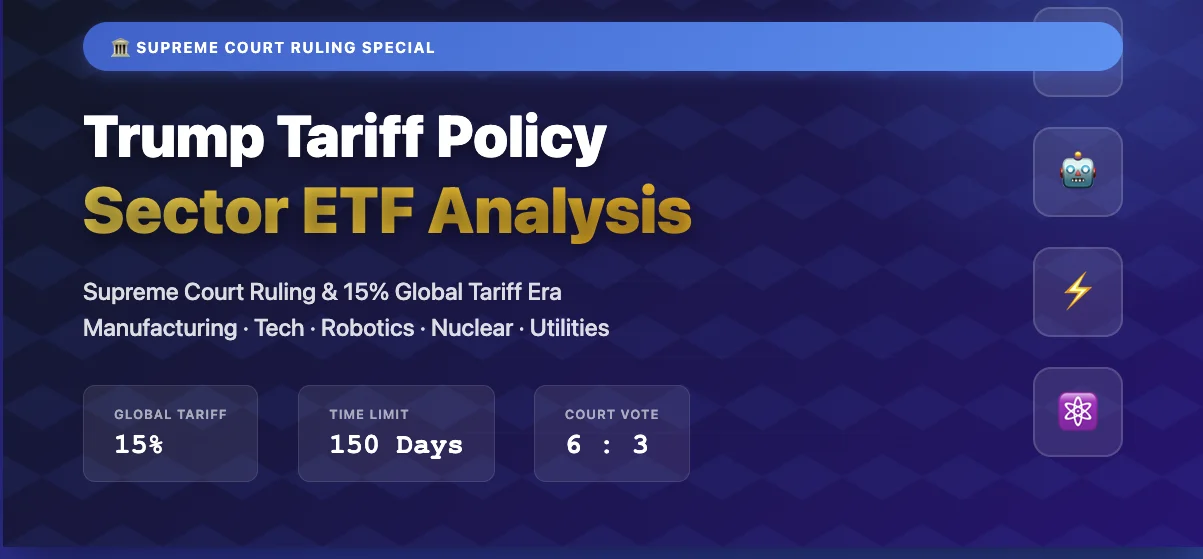
On February 20, 2026, the U.S. Supreme Court ruled that President Donald Trump’s reciprocal tariff policy was unlawful, marking a significant shift in the global trade environment. The Supreme Court, in a 6-3 decision, determined that tariff impositions based on the International Emergency Economic Powers Act (IEEPA) exceeded presidential authority, effectively dismantling the legal foundation of Trump tariff policy. However, the Trump administration immediately activated Plan B by invoking Section 122 of the Trade Act, implementing up to 15% global tariffs worldwide.
This evolution in Trump tariff policy brings both opportunities and risks to specific sectors. This comprehensive post analyzes manufacturing, technology, financial, robotics, nuclear, and utility sector ETFs that investors should focus on during this tariff policy transition period following the Supreme Court ruling, providing essential information for strategic investment decisions.
1. Trump Tariff Policy Supreme Court Ruling: What Changed
1.1 Core Elements of the Supreme Court’s Ruling
The U.S. Supreme Court issued a clear ruling of unlawfulness regarding President Trump’s designation of the trade deficit as a national emergency and his imposition of tariffs based on IEEPA. Chief Justice John Roberts stated in the opinion that “the power to impose taxes and tariffs lies with Congress,” representing a constitutional limitation on presidential tariff authority itself.
Notably, in a Supreme Court composed of 6 conservative justices and 3 liberal justices, 3 conservative justices joined the unlawfulness opinion. Even Justice Kavanaugh, appointed by Trump during his first administration, issued a dissenting opinion strongly warning of the “mess” that tariff refund procedures would create.
1.2 Trade Act Section 122 Invocation: Trump’s Plan B
Immediately following the Supreme Court ruling on February 20, Trump invoked Section 122 of the Trade Act as an alternative to existing tariffs. Section 122 of the Trade Act is a provision that allows the president to act unilaterally in cases of serious balance of payments deficits, enabling the imposition of up to 15% tariffs for a maximum of 150 days when the U.S. balance of payments records a serious deficit or when the dollar’s value changes rapidly.
President Trump initially announced a 10% global tariff, then raised it to 15% the following day. This suggests that while the form of Trump tariff policy has changed, it will essentially continue. However, Section 122 of the Trade Act has a limitation of a maximum application period of 150 days, requiring congressional approval for any extension beyond that.
1.3 Future Outlook: Potential Use of Trade Act Section 301 and Section 232
Experts predict that during the 150-day period, the Trump administration will fully activate Section 301 of the Trade Act (Super 301) and Section 232 of the Trade Expansion Act. Section 301 of the Trade Act allows for the imposition of broad retaliatory tariffs through certain procedures against countries engaging in unfair or discriminatory trade practices against the United States, while Section 232 of the Trade Expansion Act grants the president authority to restrict imports through tariffs when imports of specific items are deemed to threaten national security.
Treasury Secretary Scott Bessent stated, “There is no doubt about our ability to continue collecting tariffs at roughly the same level in terms of overall revenue,” making clear the policy to maintain tariffs. U.S. tariff revenue has surged 304% in one year to $124 billion, and since refunding this money would seriously worsen government debt problems, the Trump administration has no choice but to maintain the tariff system by any means necessary.
2. Complete Analysis of Trump Tariff Policy Beneficiary Sector ETFs
2.1 Manufacturing Sector: Focus on U.S. Domestic-Centered Manufacturers
The core of Trump tariff policy is “protecting American manufacturing and creating jobs.” With protectionist trade policies and increased tariffs on imported goods, manufacturers producing within the United States are expected to be the biggest beneficiaries. In particular, high tariffs on Chinese products are expected to work favorably for American manufacturing companies.
ACE U.S.-Centered Small-Mid Cap Manufacturing ETF
Launched by Korea Investment Trust Management, the ‘ACE U.S.-Centered Small-Mid Cap Manufacturing ETF’ focuses on small and mid-cap stocks leading America’s manufacturing renaissance. The biggest feature of this ETF is that the average U.S. domestic sales ratio of its constituent stocks reaches 93%. In other words, it consists of companies earning most of their revenue from the U.S. domestic market rather than global supply chains, allowing them to directly benefit from Trump tariff policy.
Current top holdings include Core & Main, Comfort Systems USA, Applied Industrial Technologies, SiteOne Landscape Supply, MasTec, and BWX Technologies. Diversification is well-implemented with a maximum investment ratio of about 4% per stock, and holdings and ratios are adjusted quarterly to flexibly respond to market conditions.
Investment Strategy
Even as Trump tariff policy transitions from Section 122 of the Trade Act to Sections 301 and 232, the competitiveness of U.S. domestic-centered manufacturers is expected to continue strengthening. Particularly, as reshoring policies to reduce dependence on Chinese products materialize, investment in U.S. manufacturing is expected to expand. However, given the legal uncertainty of tariff policies, diversified investment and a long-term investment perspective are necessary.
2.2 Technology Sector: AI and Deregulation Beneficiaries
Companies investing in artificial intelligence (AI) and technology are expected to be influenced by the Trump administration’s favorable policies and deregulation. In particular, AI technology gains opportunities for rapid development through governmental policy support and reduced regulation, enabling related companies to focus more on research and development.
iShares U.S. Technology ETF (IYW)
The IYW ETF is exposed to the entire technology sector, with high weighting in large-cap tech stocks but also including small and mid-cap companies to capture various opportunities in the technology sector. As it invests in innovative high-growth industries, it has high potential for long-term capital growth. The expense ratio is 0.42%, somewhat high, but it’s evaluated as a relatively affordable option for concentrated technology sector investment.
QQQ (Invesco QQQ Trust)
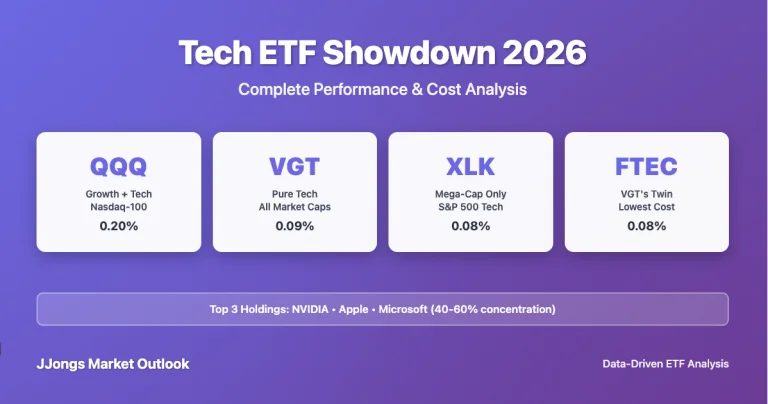
Tracking the Nasdaq 100 index, QQQ invests in America’s leading big tech companies including Apple, Microsoft, Nvidia, Meta, Amazon, and Tesla. The Trump administration’s tax cuts and deregulation are expected to positively impact these companies’ profitability. However, caution is needed regarding volatility from semiconductor supply chain restructuring as technology competition with China intensifies.
Investment Strategy
The technology sector is more likely to benefit from deregulation and tax cut policies rather than direct impacts from Trump tariff policy. However, as China containment intensifies, semiconductor supply chain uncertainty may increase, so attention should be paid to companies expanding U.S. production or those with low China dependence. VGT (Vanguard Information Technology ETF), XLK (Technology Select Sector SPDR Fund), and FTEC (Fidelity MSCI Information Technology Index ETF) can also be considered.
2.3 Robotics & Automation Sector: Core Infrastructure for Manufacturing Reshoring
As the Trump administration strongly pushes reshoring policies to bring manufacturing back to America, the importance of robotics automation technology is being highlighted. Since U.S. labor costs are high, introducing robots and automation systems is essential to secure manufacturing competitiveness. The robotics market is projected to grow from approximately $350 billion in 2024 at an average annual rate of over 10% through 2030.
Global X Robotics & Artificial Intelligence ETF (BOTZ)
BOTZ is a representative ETF investing in robotics and artificial intelligence-related companies, consisting of industrial robots, automation systems, and AI-based software companies. Particularly with high weighting in AI semiconductor companies like Nvidia, it can directly benefit from AI technology development. As of February 20, 2026, the trading price is $38.64, with a 52-week range of $23.82-$38.78.
BOTZ’s characteristics include hardware concentration, market-cap weighting methodology, large-cap focus (Nvidia, FANUC), and high Japanese company weighting. Total holdings number 51, with U.S. companies representing the largest portion at 53.27%, followed by Japanese and Swiss companies. The top 20 stocks account for 80% of the total portfolio, making it sensitive to major companies’ performance.
ROBO Global Robotics & Automation ETF (ROBO)
The ROBO ETF uses a Bellwether strategy, investing across the entire robotics industry value chain. Unlike BOTZ, it has higher small and mid-cap weighting and uses an equal-weight mixed approach, reducing dependence on specific companies. Total holdings number 88, far more than BOTZ, but the top 10 holdings each occupy only 1-2%, providing excellent diversification benefits.
Investment Strategy
The robotics automation sector is directly connected to Trump’s reshoring policy, holding strong growth momentum for the medium to long term. However, given the rapid pace of technological development and large competitive differences between companies, diversified investment through ETFs is more advantageous than individual stocks. BOTZ suits aggressive investment centered on AI semiconductors, while ROBO suits stable diversified investment across the industry. ARKQ (ARK Autonomous Technology & Robotics ETF) can also be considered as a high-risk, high-reward option focusing on Tesla and autonomous driving.
2.4 Nuclear Energy Sector: Essential Energy Source for the AI Era
On May 23, 2025, President Trump signed four executive orders to expand the nuclear power industry, ending 40 years of denuclearization policy. The core goal is to establish energy independence for AI technology supremacy and national security, announcing specific plans to expand nuclear power generation capacity fourfold to 400GW by 2050, commence construction of 10 large reactors by 2030, and limit new reactor licensing review periods to 18 months.
Global X Uranium ETF (URA)
URA is an ETF investing across the nuclear power industry, from uranium mining to reactor operations and nuclear component production. It tracks the Solactive Global Uranium & Nuclear Components Index, with top holdings including Cameco, Sprott Physical Uranium Trust, and NexGen Energy. The expense ratio is 0.69%, with an average annual return of 13.29% over the past 5 years.
URA’s characteristics include a very high energy sector weighting of 95.88% and sensitivity to uranium price fluctuations. As of May 28, 2025, the YTD return was 32.7%, the highest performance among nuclear ETFs.
VanEck Uranium+Nuclear Energy ETF (NLR)
NLR invests in companies deriving at least 50% of revenue from the nuclear energy industry. Unlike URA, it has higher weighting in nuclear power plant operators and reactor construction infrastructure companies rather than uranium mining companies (utilities sector 46.63%). The expense ratio is 0.56%, lower than URA, with a YTD return of 25.6%.
Sprott Uranium Miners ETF (URNM)
URNM is an ETF concentrating on uranium mining and exploration companies, with energy sector weighting reaching 84.5%. Major investment companies include Cameco, NAC Kazatomprom, and Sprott Physical Uranium Trust. The management fee ratio is the highest at 0.75%, but the average annual return over the past 3 years was very high at 39.90%.
Investment Strategy
The nuclear energy sector is expected to see strong medium to long-term growth due to Trump administration policy support and surging electricity demand from AI industry development. However, given uranium price volatility and political risks, it’s advisable to approach gradually with 10-20% portfolio weighting. URA provides diversity and stability, URNM provides upside sensitivity, and NLR provides defensiveness, so a mixed strategy can be considered. Domestic listed ETFs include RISE Global Nuclear, PLUS Global Nuclear Value Chain, SOL U.S. Nuclear SMR, and HANARO Nuclear iSelect.
2.5 Power Infrastructure Sector: Essential Element for Manufacturing Reshoring
As Trump strongly pushes reshoring policies to bring manufacturing back to America, the importance of power grid investment is growing. To build and operate factories, stable electricity supply is essential, so the power grid must be properly established to activate manufacturing. With AI’s increased power consumption, aging power grid replacement, and manufacturing reshoring, the power infrastructure industry is emerging as an essential field, not just a trend.
Global X GRID ETF (GRID)
The GRID ETF is a representative ETF investing in global power infrastructure companies. Over the past 3 months, approximately 437 billion won (Korean won basis) has flowed in, representing the top 4.7% of fund inflows among U.S. equity ETFs. This demonstrates that global investors highly value the potential of the power grid industry.
Kiwoom Global Power GRID Infrastructure ETF
Korean investors can diversify investment in global power infrastructure companies through Kiwoom Investment Asset Management’s ‘Kiwoom Global Power GRID Infrastructure ETF’. It invests in power transmission and distribution infrastructure, smart grids, and power management systems regardless of generation method, providing stable yet high-growth-potential investment opportunities.
Investment Strategy
The power infrastructure sector has secured long-term growth drivers as Trump’s reshoring policy and AI industry development combine. Since it invests in the power grid itself regardless of generation method, risks from energy policy changes are relatively low. However, during interest rate hike periods, stock prices may be sluggish due to the utility sector’s characteristics, so interest rate trends should be monitored.
2.6 Financial Sector: Maximum Beneficiary of Tax Cuts and Deregulation
The Trump administration’s tax cut policies and financial deregulation are expected to directly benefit the financial sector. Corporate tax rate reductions will improve financial institutions’ profitability, and deregulation is expected to activate banks’ lending and investment activities.
Financial Select Sector SPDR Fund (XLF)
XLF is a representative ETF investing in financial sector companies within the S&P 500 index. It includes major U.S. banks like JPMorgan Chase, Bank of America, and Wells Fargo, along with insurers and asset managers. The very low expense ratio of 0.10% makes it advantageous for long-term investment.
Investment Strategy
The financial sector is expected to directly benefit from the Trump administration’s tax cuts and deregulation policies, but economic slowdown risks from tariff policies also exist. If tariff increases cause inflation and trigger Fed interest rate hikes, it could be positive for the financial sector, but if it leads to economic recession, it could be negatively impacted by increased loan defaults. Therefore, economic indicators and Fed monetary policy must be closely monitored.
3. Investment Strategies Based on Trump Tariff Policy Changes
3.1 Short-term vs Long-term Investment Strategies
Since Section 122 of the Trade Act is a temporary measure for a maximum of 150 days, short-term volatility may be high. Since the Trump administration is highly likely to establish a long-term tariff system through Section 301 of the Trade Act or Section 232 of the Trade Expansion Act within 150 days, short-term investors should watch market reactions to policy announcements.
Long-term investors should focus on the essential direction rather than form changes in tariff policy. Since the Trump administration’s “America First” and “manufacturing protection” stance will continue regardless of legal basis changes, a long-term investment perspective in U.S. domestic-centered companies, reshoring beneficiaries, and AI and automation infrastructure companies remains valid.
3.2 Diversification and Risk Management
Since Trump tariff policy still has legal uncertainty, diversifying across multiple sectors is preferable to concentrating investment in specific sectors or stocks. Since each sector like manufacturing, technology, robotics, nuclear, power infrastructure, and finance has different risk factors and growth drivers, diversifying portfolios can mitigate shocks from specific policy changes.
Additionally, investing through ETFs has the advantage of reducing individual stock company risks while participating in entire sector growth. However, since each ETF has different constituent stocks and management strategies, it’s important to accurately understand each ETF’s characteristics and select products matching your investment style.
3.3 Importance of Policy Change Monitoring
Trump tariff policy may change executive orders and legal basis frequently, so continuous monitoring of policy changes is necessary. Particularly important monitoring points include when Section 122 of the Trade Act’s 150-day deadline expires, progress of Section 301 Trade Act investigations, and whether Section 232 of the Trade Expansion Act application expands to additional items.
Additionally, monitoring retaliatory tariff measures from major trading partners like China, the European Union, Canada, and Mexico, and WTO lawsuit progress is necessary. If trade disputes intensify, concerns about global supply chain disruption and economic slowdown may grow, potentially requiring defensive portfolio adjustments.
4. Investment Precautions and Risk Factors
4.1 Legal Uncertainty
Since the Supreme Court ruled tariffs based on IEEPA unlawful, Section 122, 301, and 232 of the Trade Act may also face legal challenges. Particularly, Section 122 of the Trade Act has rarely been used historically, making legal interpretation unclear, and given the Supreme Court’s emphasis on constitutional limitations on presidential tariff authority, new lawsuits are highly likely.
4.2 Economic Slowdown Risk
Tariff increases can cause inflation through rising import prices and weaken consumer purchasing power, leading to economic slowdown. The International Monetary Fund (IMF), Organization for Economic Cooperation and Development (OECD), and World Bank have all announced downward revisions to global economic growth rates due to Trump tariff policy, and if trade disputes intensify, recession concerns may grow.
4.3 Retaliatory Tariffs and Trade Disputes
Major trading partners including China, the European Union, Canada, and Mexico are responding to U.S. tariff impositions with retaliatory tariffs, and legal responses including WTO lawsuits are also underway. If trade disputes become prolonged, comprehensive economic shocks may occur including global supply chain restructuring, increased corporate production costs, and rising consumer prices.
4.4 Dollar Strength and Exchange Rate Risk
Trade disputes from tariff policies can strengthen the safe-haven preference phenomenon, causing dollar strength. Dollar strength can weaken U.S. companies’ export competitiveness and trigger capital outflows from emerging markets. Korean investors should also consider exchange rate loss risks from currency fluctuations.
5. Conclusion: Smart Investment Strategy for the Trump Tariff Policy Era
While Trump tariff policy’s legal basis has changed due to the Supreme Court ruling, the essential direction of “America First” and “manufacturing protection” has not changed. Section 122 of the Trade Act’s 15% global tariff is a temporary measure, but a long-term tariff system is highly likely to be established through Section 301 of the Trade Act and Section 232 of the Trade Expansion Act thereafter.
Investors should respond to this policy environment change by focusing on U.S. domestic-centered manufacturing, AI and automation infrastructure, nuclear and power infrastructure, and deregulation-benefiting financial sectors. However, considering legal uncertainty, economic slowdown risks, and trade dispute intensification possibilities, thorough diversification and risk management are essential.
Sector investment through ETFs is an effective method to reduce individual stock risks while participating in policy-benefiting sector-wide growth. It’s important to accurately understand each ETF’s characteristics and constituent stocks, and construct a portfolio matching your investment style and goals.
Trump tariff policy will continue to evolve, and market reactions to policy changes are expected to be volatile. The key to successful investment is closely monitoring policy announcements, legal rulings, and trade negotiation progress while responding flexibly.
Related Previous Posts
Energy Sector ETF Comparison Analysis: XLE, VDE, TAN, SOLAR Complete Guide
How to Read ETF Fact Sheets: Complete Guide to Performance, Fees, and Risk Analysis
⚠️ Disclaimer: I am not a licensed financial advisor. Content here is for educational purposes only and should not be considered personalized investment advice. Always do your own research before making investment decisions.