AMD-Meta $100B Deal Sparks AI Bubble Fears: When Stock Warrants Replace Cash
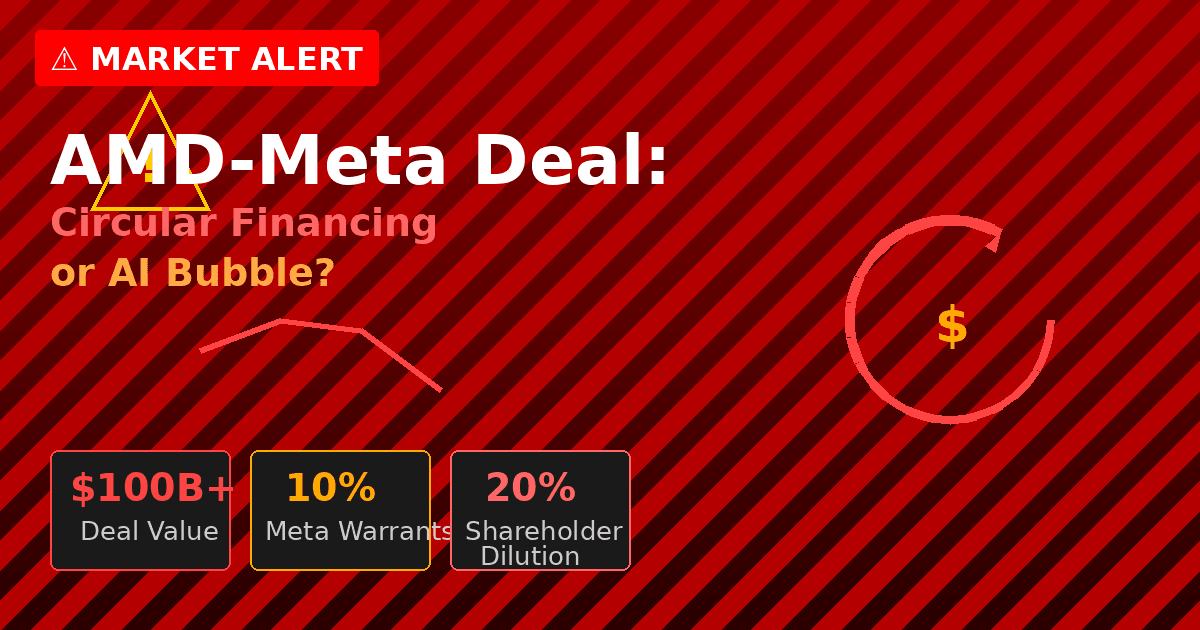
AMD shares surged 11% in pre-market trading Monday following a blockbuster announcement: a multi-year partnership with Meta to deploy 6 gigawatts of AI computing power valued at over $100 billion. But buried in the press release’s fine print lies a detail that should concern every investor watching the AI boom: Meta isn’t paying for these chips with cash. Instead, AMD is issuing Meta warrants to acquire 160 million shares—roughly 10% of the company—at just $0.01 per share.
This marks the second time in four months AMD has structured a massive AI deal around equity dilution rather than traditional payments. In October 2025, AMD granted OpenAI an identical warrant structure for another 6-gigawatt, $100+ billion commitment. The pattern raises an uncomfortable question: Are we witnessing brilliant strategic financing, or is this the AI industry’s version of the dot-com era’s circular financing schemes that preceded the 2000 crash?
The Deal Structure: What AMD and Meta Actually Agreed To
On the surface, the AMD-Meta partnership represents a massive win for AMD in its battle against Nvidia’s AI chip dominance. Under the agreement:
- Deployment Scale: Meta commits to deploying up to 6 gigawatts of AMD Instinct GPUs across multiple generations
- Timeline: First 1-gigawatt deployment begins second half of 2026 using custom MI450 GPUs based on AMD’s new architecture
- Hardware Ecosystem: Includes AMD’s 6th Gen EPYC CPUs (codenamed “Venice” and “Verano”), ROCm software, and AMD Helios rack-scale architecture
- Revenue Potential: AMD CFO Jean Hu stated the partnership will “drive substantial multi-year revenue growth and be accretive to our non-GAAP earnings per share”
- Strategic Alignment: Deep collaboration across GPU/CPU silicon, systems, and software roadmaps optimized for Meta’s AI workloads
According to AMD’s projections, each gigawatt of computing capacity represents chip revenue measured in “several tens of billions of dollars.” With Meta committing to 6 gigawatts, the total deal value could exceed $100 billion over the partnership’s lifespan.
This follows Meta CEO Mark Zuckerberg’s announcement last week of a separate deal to deploy “millions” of Nvidia GPUs, with Meta’s 2026 capital expenditure budget reaching up to $135 billion. Meta is simultaneously partnering with multiple chip providers—Nvidia, AMD, and developing its own in-house silicon—to meet its “personal superintelligence” vision requiring tens of gigawatts of data center capacity this decade.
The Warrant Structure: Equity Instead of Cash
Here’s where the deal gets unconventional. Rather than Meta paying AMD billions of dollars upfront or through traditional purchase orders, AMD issued Meta a performance-based warrant for up to 160 million AMD shares. The warrant structure includes:
Vesting Mechanics
- First Tranche: Vests when the first 1 GW of Instinct GPUs are shipped (second half 2026)
- Additional Tranches: Vest progressively as Meta purchases scale from 1 GW up to 6 GW
- Stock Price Thresholds: Warrants fully vest only if AMD’s stock reaches specific price targets, with the final tranche requiring AMD stock to hit $600 per share (currently trading around $196)
- Technical/Commercial Milestones: Meta must meet unspecified “technical and commercial considerations” for each warrant tranche to unlock
- Exercise Price: $0.01 per share—essentially free shares if conditions are met
The Math: What Meta Could Gain
If AMD’s stock reaches $600 and Meta exercises all 160 million warrants:
- Meta would own approximately 10% of AMD
- At $600/share, Meta’s stake would be worth $96 billion
- Effective cost: $1.6 million ($0.01 × 160 million shares)
- This equity stake could theoretically pay for most or all of Meta’s GPU purchases from AMD
UBS analyst Timothy Arcuri noted in his October 2025 analysis of the OpenAI deal: “The final 6th tranche requires ~$1T market cap to vest – ergo, if [the customer] were to hold stock until the end of the deal, its stake would be worth ~$100B.”
Shareholder Dilution Impact
For existing AMD shareholders, this represents significant dilution. AMD currently has approximately 1.6 billion shares outstanding. Adding 160 million new shares (another 160 million for the October OpenAI deal) would increase the share count by 20%, diluting existing shareholders’ ownership proportionally.
AMD’s stock structure now includes potential dilution from three major warrant issuances:
- OpenAI: 160 million shares (October 2025)
- Meta: 160 million shares (February 2026)
- Potential Total Dilution: Up to 320 million shares or ~20% of current outstanding
Déjà Vu: The OpenAI Precedent
AMD’s Meta deal is not a one-off experiment—it’s a repeat of the exact same structure used with OpenAI four months ago. On October 6, 2025, AMD announced an identical 6-gigawatt agreement with OpenAI, also granting 160 million share warrants at $0.01 per share with the same vesting structure tied to deployments and stock price milestones up to $600.
The market reaction to the OpenAI deal was explosive: AMD stock surged 24% in pre-market trading and rose 43% over the following week. However, questions immediately emerged about the sustainability of this financing model.
Even Nvidia CEO Jensen Huang expressed surprise at AMD’s willingness to give away equity, stating in an October 2025 CNBC interview: “It’s imaginative, it’s unique and surprising, considering they were so excited about their next-generation product. I’m surprised that they would give away 10% of the company before they even built it.”
The Circular Financing Critique: AI Bubble Comparisons
Industry critics have increasingly labeled these arrangements as “circular financing”—a pattern where companies use their own equity or debt to finance customer purchases of their products, creating the appearance of revenue growth without corresponding cash generation.
How Circular Financing Works in AI
The AI infrastructure boom has created a complex web of interconnected deals where money flows in circles:
- Nvidia → OpenAI: Nvidia invests up to $100 billion in OpenAI (September 2025)
- OpenAI → Nvidia: OpenAI commits to purchasing millions of Nvidia GPUs with Nvidia’s own money
- AMD → OpenAI/Meta: AMD grants equity warrants effectively financing chip purchases
- OpenAI/Meta → AMD: Customers “pay” for chips by eventually selling AMD stock (diluting existing shareholders)
- Oracle → OpenAI: Oracle builds data centers for OpenAI, buying Nvidia chips with funds that flow back to Nvidia
- CoreWeave: Nvidia holds 7% equity stake in cloud provider CoreWeave, which buys Nvidia chips
According to The Register’s November 2025 analysis, this creates “an expanding constellation of partners and customers, many of which have also become investors and investees” around Nvidia and AMD. Money circulates among a handful of companies—Nvidia, AMD, OpenAI, Microsoft, Oracle, Meta, CoreWeave, xAI—creating the impression of explosive growth while raising questions about whether valuations are inflated by self-reinforcing deals rather than organic user demand.
Dot-Com Bubble Parallels
The circular financing model draws uncomfortable comparisons to late-1990s telecom and internet infrastructure deals:
- Vendor Financing: Cisco, Lucent, and Nortel extended billions in loans to telecom startups to buy their networking equipment
- Stock-Based Payments: Companies paid vendors with equity rather than cash, inflating revenues without cash generation
- Reciprocal Purchases: Companies bought each other’s products in circular arrangements that boosted revenues for both
- Revenue Without Profit: Spectacular revenue growth masked unsustainable business models dependent on continued fundraising
- The Crash: When the music stopped in 2000-2001, many of these arrangements unwound catastrophically
Highline Wealth Partners’ October 2025 analysis highlighted the systemic risks: “If AI productivity gains are delayed or limited, experts warn that a weak link in this tightly interconnected ecosystem could trigger a sharp correction in tech stocks.”
Financial Sustainability Concerns
OpenAI’s financial profile amplifies these concerns. The company reported $4.3 billion in sales but burned $2.5 billion in the first half of 2025. CEO Sam Altman has stated OpenAI expects to invest “trillions” in physical infrastructure, yet the company isn’t expected to be cash-flow positive until near the end of the decade.
How will OpenAI fund $100+ billion in chip purchases from AMD (plus $100+ billion from Nvidia, $300 billion from Oracle, etc.)? The current answer: equity warrants, debt, and future fundraising rounds—not operating cash flow. This debt-fueled infrastructure spending creates mounting liabilities on a young balance sheet with uncertain monetization timelines.
The Bull Case: Strategic Alignment, Not Financial Engineering
Despite circular financing concerns, AMD and industry supporters argue these warrant structures represent intelligent strategic alignment rather than dubious financial engineering.
Alignment of Interests
AMD CFO Jean Hu stated the Meta deal creates “significant strategic alignment and shareholder value for both AMD and Meta” with “the performance-based structure tightly aligning AMD and Meta around execution and long-term value creation.”
The warrant structure creates powerful incentives:
- For Meta: Vested interest in AMD’s success incentivizes Meta to help optimize AMD chips, provide engineering feedback, and ensure deployment success
- For AMD: Secures massive, multi-year anchor customer providing validation for Instinct GPU roadmap and reducing single-vendor dependency risk for hyperscalers
- For Both: Shared upside if AMD stock appreciates; Meta gains financially from AMD’s broader market success beyond just chip purchases
This transforms Meta from a simple customer into a strategic partner with skin in the game. If AMD’s MI450 GPUs underperform or deployment hits obstacles, Meta loses not just productivity but also equity value.
Demand Validation, Not Revenue Fabrication
Unlike dot-com vendor financing where demand was speculative, the AI compute hunger is demonstrably real. Meta is simultaneously:
- Deploying millions of Nvidia GPUs (deal announced February 17, 2026)
- Committing to 6 GW of AMD GPUs (announced February 24, 2026)
- Developing proprietary in-house silicon
- Planning to spend up to $135 billion on AI infrastructure in 2026 alone
According to Meta infrastructure head Santosh Janardhan: “The scale of the company’s data center buildout simply requires multiple chip suppliers. All of the chip makers end up having sort of a seat at the table.”
Meta isn’t the only hyperscaler with insatiable AI compute appetite. Amazon, Microsoft, and Google are collectively spending $300+ billion on AI data centers in 2026. This demand is visible in product telemetry, enterprise contracts, and API usage—not purely speculative like late-1990s internet traffic projections.
Competitive Necessity
From AMD’s perspective, warrant-based financing may represent competitive necessity rather than preference. Nvidia dominates 70%+ of the AI chip market with an ecosystem (CUDA software, developer tools, established relationships) that AMD can’t match overnight.
AMD CEO Lisa Su acknowledged this reality, stating: “Meta has a lot of choices. I want to make sure that we are always a clear seat at the table when they think about what they need next.”
By financially engineering deals that cost hyperscalers minimal upfront cash while providing upside participation, AMD secures market share it might otherwise lose to Nvidia. The warrants are the price AMD pays for breaking into accounts dominated by its rival.
Revenue Accretion Despite Dilution
AMD maintains these deals are “highly accretive to non-GAAP earnings per share” despite the dilution. The company argues that revenue from multi-gigawatt deployments (tens of billions per gigawatt) will more than offset the EPS impact of 10% share count increases.
If AMD’s stock reaches $600 (requiring roughly $1 trillion market cap) to fully vest the warrants, shareholders—while diluted—would have experienced a 3x stock appreciation from current levels. In this scenario, dilution becomes less painful as the overall pie grows substantially.
The Critical Questions Investors Must Ask
As AMD stock surges on the Meta announcement, investors face crucial questions that will determine whether this represents a buying opportunity or a warning signal:
1. Can AMD Execute at Gigawatt Scale?
Deploying 6 gigawatts of GPUs represents unprecedented complexity:
- Manufacturing: AMD must produce hundreds of thousands of MI450 GPUs without supply chain disruptions
- Customization: Meta helped design the MI450 for its specific workloads—execution risk if optimization falls short
- Software Stack: Meta must adapt its infrastructure to AMD’s ROCm software, away from Nvidia’s dominant CUDA
- Rack-Scale Integration: AMD Helios architecture is new; large-scale deployment may uncover integration challenges
If AMD misses deployment milestones, warrants may not vest, but reputational damage could be severe. Meta’s confidence in AMD hardware is essential for AMD to win other hyperscaler accounts.
2. What Happens if AMD Stock Stagnates?
The warrant structure requires AMD stock to reach $600 for Meta (and OpenAI) to receive full equity value. Currently trading at $196, this represents a 3x appreciation. Key considerations:
- If AMD stock remains below price thresholds, Meta receives less value, reducing the effective financing benefit
- AMD still delivers billions in chips but without proportional warrant vesting—creating revenue without the intended equity offset
- Meta might lose incentive to prioritize AMD deployments if equity upside evaporates
The final warrant tranche requires AMD to reach roughly $1 trillion market cap (current: ~$315 billion at $196/share). This would require AMD to approach Nvidia’s current valuation—a significant long shot if Nvidia maintains AI market dominance.
3. How Will Existing Shareholders React to 20% Dilution?
AMD is issuing warrants for 320 million shares (160M to OpenAI, 160M to Meta) representing ~20% dilution when fully exercised. If AMD announces additional warrant-based deals (Google? Amazon? Microsoft?), dilution could accelerate further.
At what point do existing shareholders rebel against equity-based customer financing? If AMD’s strategy becomes “trade ownership for revenue,” long-term shareholders may question whether they’re benefiting from growth or merely subsidizing it.
4. What’s the Exit Strategy?
Meta and OpenAI will eventually want to monetize their AMD holdings. When they sell—either to pay for chips or realize gains—who buys? Potential scenarios:
- Gradual Sales: Meta/OpenAI sell AMD shares incrementally to fund chip purchases, creating persistent selling pressure
- Secondary Offering: AMD facilitates a large secondary offering to provide liquidity, diluting share value
- Hold Long-Term: Meta/OpenAI become long-term AMD investors (unlikely given they’re not investment funds)
UBS analyst Timothy Arcuri believes the likely scenario is that customers “will sell AMD stock along the way to pay the AMD bill”—creating multi-year overhang as hundreds of millions of shares hit the market.
5. Is the AI Infrastructure Buildout Sustainable?
The elephant in the room: Are hyperscalers building capacity that will generate returns justifying the investment?
- Meta’s AI Monetization: Meta is spending $135 billion on AI infrastructure in 2026, but how much revenue will AI features generate? Advertising remains Meta’s core business; AI is speculative
- OpenAI’s Burn Rate: Spending “trillions” on infrastructure while burning $2.5B semi-annually raises fundamental questions about path to profitability
- Utilization Rates: Will these gigawatts of compute capacity be fully utilized, or will AI demand plateau before justifying the buildout?
If AI monetization disappoints—if ChatGPT subscriptions stagnate, enterprise AI adoption lags projections, or AI features fail to drive incremental revenue—the entire infrastructure spending wave could reverse. In that scenario, circular financing unwinds catastrophically, just like vendor financing collapsed in 2000-2001.
Technical Analysis: AMD Stock After the Meta News
AMD shares at $196.60 (pre-Meta announcement) were already trading above their 200-day moving average of $184.50, indicating a pre-news uptrend base. The +11% pre-market surge to ~$217 pushes the stock into potentially overbought territory.
Key Technical Levels
- Resistance: $220-225 (previous 2024 highs), $250 (psychological level), $300 (requires sustained AI momentum)
- Support: $196 (pre-announcement level), $185 (200-day MA), $165 (October 2025 pre-OpenAI deal level)
- Volume: Pre-announcement volume of 27.8M shares was below the 20-day average of 39.2M—expect explosive volume surge on the open
Historical Pattern
After the October 6, 2025 OpenAI announcement, AMD stock:
- Surged 24% in pre-market
- Rose 43% over the following week
- Consolidated for several weeks before trending higher
- Never gave back the full gains despite circular financing concerns
This suggests the Meta deal will likely produce a sustained rally, at least in the near term, as momentum traders and institutional investors position for AMD’s growing market share in AI chips.
What This Means for Tech Investors
The AMD-Meta partnership presents a bifurcated investment thesis:
Bull Case: Buy the Transformation
- AMD is winning massive design wins with the world’s largest AI infrastructure builders
- The warrant structure aligns long-term interests and validates AMD’s technology roadmap
- Meta joining OpenAI as 6GW customers provides AMD with 12GW of committed demand through 2030
- AI infrastructure spending is real, driven by demonstrated demand not speculation
- Stock reaching $600 (3x from here) would reward believers despite dilution
- Breaking Nvidia’s monopoly creates long-term competitive dynamics favoring AMD
Bear Case: Avoid the Bubble
- Circular financing echoes late-1990s telecom vendor financing that ended catastrophically
- 20% shareholder dilution transfers value from existing investors to new customers
- OpenAI’s financial sustainability is questionable; $2.5B semi-annual burn rate with unclear path to profitability
- Warrant overhang creates multi-year selling pressure as Meta/OpenAI monetize holdings
- If AI monetization disappoints, entire infrastructure spending wave reverses
- AMD stock must reach $600 for warrants to fully vest—requires near-Nvidia valuation despite smaller market share
Portfolio Positioning
For investors navigating this environment, several strategies merit consideration:
For AMD Bulls: Use this rally to establish or add to positions, but implement risk management with stop-losses below $185 (200-day MA). Consider selling covered calls at $250-300 strikes to harvest premium from elevated implied volatility.
For AMD Bears: Wait for the initial euphoria to fade before establishing short positions or buying puts. The October OpenAI deal produced a multi-week rally; shorting into strength could be painful. Alternatively, consider spreads (bull put or bear call spreads) to limit downside exposure while maintaining bearish bias.
For AMD Neutrals: Monitor execution on OpenAI and Meta deployments through 2026. If AMD successfully ships the first 1GW to each customer without major hiccups, bull case strengthens. If delays emerge or integration problems surface, bear case gains credibility. The next 6-12 months will provide crucial data.
Broader Market Implications: AI Bubble or New Paradigm?
The AMD-Meta deal transcends a single stock story—it’s a stress test for the entire AI investment thesis.
If Bulls Are Right
AI represents a genuine paradigm shift comparable to the internet’s actual impact (post-bubble). Infrastructure spending, while extreme, is justified by forthcoming productivity gains and new revenue streams. Companies building AI capacity today will dominate the next decade of technology. Circular financing is merely creative deal-making necessitated by the unprecedented scale and speed of buildout required.
In this scenario:
- Tech megacaps (Microsoft, Google, Meta, Amazon) successfully monetize AI investments through new products, efficiency gains, and market share expansion
- OpenAI and Anthropic become trillion-dollar companies providing AI infrastructure to the economy
- AMD, Nvidia, and other chip companies enjoy sustained multi-year growth as AI computing becomes as essential as electricity
- Today’s valuations, while elevated, prove justified by 2028-2030 earnings
If Bears Are Right
AI is overhyped with applications failing to generate economic returns justifying infrastructure spending. The circular financing web unravels when a weak link emerges—perhaps OpenAI fails to achieve profitability, or Meta’s AI features fail to drive incremental revenue. Stock-based compensation and vendor financing inflate revenues without corresponding value creation.
In this scenario:
- Hyperscalers slash CapEx as AI ROI disappoints; utilization rates plummet
- AMD and Nvidia see order cancellations; stock-based deals become liabilities as share prices collapse
- OpenAI faces solvency crisis; warrant holders dump AMD stock to raise cash
- Tech sector experiences 2000-style correction as circular financing unwinds
- AI winter follows AI summer; genuine applications emerge but much later and more slowly than anticipated
Historical Context: When Stock-Based Deals Work (And When They Don’t)
To understand whether AMD’s warrant strategy represents genius or folly, it’s instructive to examine historical precedents where companies used equity as currency for strategic partnerships.
Success Stories: Strategic Equity Alignment
Amazon-Rivian Partnership (2019): Amazon invested $700 million in electric vehicle startup Rivian and committed to purchasing 100,000 electric delivery vans. Amazon’s equity stake aligned incentives—Rivian gained a committed customer and capital, while Amazon benefited from Rivian’s stock appreciation (briefly reaching $100+ billion valuation). The partnership worked because both parties had complementary strategic objectives beyond pure financial engineering.
Apple-ARM Holdings: Apple’s long-standing relationship with ARM, including periodic investments and technology licensing deals, enabled Apple’s M-series chip success. Apple’s financial commitment to ARM ensured access to cutting-edge IP while ARM gained validation from the world’s most valuable technology company. The relationship created genuine value for both parties over decades.
Microsoft-OpenAI (Pre-Circular Era): Microsoft’s initial $1 billion investment in OpenAI (2019) and subsequent $10 billion investment (2023) provided capital for OpenAI’s research while securing Microsoft exclusive Azure cloud hosting rights. This created clear value: OpenAI got funding for expensive AI research, Microsoft got exclusive access to GPT models. Both parties benefited without circular financing mechanics.
Cautionary Tales: When Equity Deals Collapse
Nortel-Vendor Financing (1998-2000): Telecommunications equipment giant Nortel extended $3.5 billion in loans and vendor financing to telecom startups to purchase Nortel equipment. When the telecom bubble burst in 2000-2001, these customers defaulted, leaving Nortel holding worthless receivables. The company’s stock collapsed from $124 to under $1, eventually filing for bankruptcy in 2009. The lesson: revenue without corresponding cash collection creates catastrophic risk when cycles turn.
Cisco-Optical Equipment Bubble (2000): Cisco Systems acquired dozens of optical networking companies using its inflated stock as currency during the late-1990s bubble. When the bubble burst, Cisco took massive write-downs on overpriced acquisitions, and its stock fell 86% from peak. Using stock as currency works brilliantly in bull markets but amplifies losses when valuations revert.
WorldCom-MCI Merger (1998): WorldCom used its inflated stock to acquire MCI Communications for $37 billion in one of the largest mergers in history. The deal was premised on continued telecom growth and WorldCom’s stock appreciation. When growth slowed and accounting fraud emerged, the merger unraveled catastrophically, leading to the largest bankruptcy in U.S. history at the time.
The AMD-Meta Deal: Which Category?
AMD’s warrant structure shares characteristics with both success stories and cautionary tales:
Like Success Stories: Genuine strategic alignment (Meta benefits from AMD’s chip development; AMD gains crucial hyperscaler customer), technology collaboration (joint optimization of MI450 for Meta workloads), and multi-year commitment creating stability for both parties.
Like Cautionary Tales: Revenue recognition without corresponding cash collection, reliance on stock appreciation for deal economics to work, potential overbuilding of capacity exceeding sustainable demand, and circular flows where suppliers finance customers’ purchases of their own products.
The distinguishing factor will be sustainable end-user demand. If Meta’s AI infrastructure generates genuine economic returns through improved products, efficiency gains, or new revenue streams, the deal succeeds. If AI monetization disappoints and infrastructure sits underutilized, the parallel to Nortel’s vendor financing becomes uncomfortably apt.
The Competitive Landscape: NVIDIA’s Shadow Looms Large
AMD’s warrant-based strategy cannot be understood without acknowledging Nvidia’s overwhelming market dominance and the desperation required to compete.
NVIDIA’s Ecosystem Advantages
Nvidia controls over 70% of the AI chip market through:
- CUDA Software Ecosystem: Nvidia’s proprietary CUDA platform has become the de facto standard for AI development, with millions of developers trained on CUDA tools and frameworks
- First-Mover Advantage: Nvidia recognized AI’s potential earlier than competitors, building a decade-long head start in optimizing GPUs for machine learning
- Vertical Integration: Nvidia’s NVLink interconnect technology, DGX systems, and end-to-end solutions create switching costs for customers
- Developer Mindshare: Most AI researchers and engineers default to Nvidia; moving to AMD requires retraining, code migration, and risk tolerance
Against this entrenched advantage, AMD faces an uphill battle. Traditional competitive strategies—better performance, lower prices, superior service—may prove insufficient given Nvidia’s ecosystem lock-in.
The Warrant Strategy as Competitive Necessity
From this perspective, AMD’s willingness to grant massive equity warrants becomes more understandable as competitive desperation rather than financial engineering excess. AMD needs to offer hyperscalers something Nvidia cannot or will not: ownership upside.
Nvidia doesn’t need to grant warrants because customers have no alternative. If Meta wants cutting-edge AI GPUs at scale, Nvidia is the primary option. But if AMD can make the economic case compelling enough—”buy our chips and become our partner-owner”—it creates differentiation in a market where technical differentiation alone may be insufficient.
This explains why AMD granted identical warrant structures to both OpenAI and Meta. It’s not financial engineering for its own sake; it’s a calculated strategy to buy market share in a market where the incumbent’s advantages would otherwise be insurmountable.
Can AMD Build a Sustainable Moat?
The critical question: Will AMD’s warrant-driven market share gains prove sustainable, or will they evaporate once warrants vest and the economics normalize?
If Meta and OpenAI successfully deploy AMD GPUs at gigawatt scale and achieve satisfactory performance, they become reference customers that validate AMD’s technology for other hyperscalers. This creates a virtuous cycle where AMD’s ecosystem strengthens with each major win.
Conversely, if deployments encounter problems—software incompatibilities, performance shortfalls, integration challenges—the warrant strategy could backfire. AMD would have granted away 20% of its equity for customer relationships that don’t translate into broader market share expansion.
Regulatory and Accounting Implications
AMD’s warrant-based deals raise complex regulatory and accounting questions that investors should monitor closely.
SEC Scrutiny of Revenue Recognition
The SEC has historically scrutinized vendor financing arrangements for aggressive revenue recognition. Key questions regulators may ask:
- Revenue Timing: Should AMD recognize revenue when chips ship, or only when customers exercise warrants and provide cash?
- Valuation of Warrants: How should AMD value the warrants granted? As operating expenses offsetting revenue? As equity compensation?
- Collectability: If customers can “pay” by selling AMD stock, does this meet SEC standards for collectability of receivables?
- Related Party Considerations: Once Meta owns 10% of AMD, do transactions between them require related-party disclosures?
While AMD has structured these deals in consultation with auditors and legal counsel, the unprecedented scale and novelty of the arrangements could attract regulatory attention, particularly if the circular financing narrative gains traction among policymakers concerned about AI bubble risks.
Tax Implications
The warrant structure creates complex tax consequences for both parties:
For AMD: Issuing warrants may create tax deductions for equity compensation, potentially offsetting taxable income from chip sales. However, if the IRS views warrants as payment for services rather than pure equity incentives, different tax treatment could apply.
For Meta: Exercising warrants at $0.01/share and immediately selling at $600 would create massive capital gains tax liability. If Meta instead holds AMD stock long-term, it defers taxes but creates concentration risk in its investment portfolio.
Antitrust Considerations
If AMD grants similar warrants to Google, Amazon, and Microsoft, the combined ownership stake of major tech companies in AMD could exceed 40-50%. This raises potential antitrust concerns:
- Common Ownership: Competing hyperscalers owning the same chip supplier could facilitate coordination or information sharing
- Foreclosure Risk: If Meta owns 10% of AMD, could it pressure AMD to deprioritize or delay shipments to Meta’s competitors?
- Board Representation: At 10% ownership, Meta might seek AMD board seats, creating potential conflicts of interest
While these concerns may not trigger immediate regulatory action, they represent latent risks that could materialize if regulators grow concerned about market concentration in AI infrastructure.
What Other Chip Companies Can Learn (Or Should Avoid)
AMD’s warrant strategy sets a precedent that other semiconductor companies may feel pressure to follow—or explicitly reject.
Potential Imitators
Intel: Intel’s struggling foundry business could offer hyperscalers equity in exchange for long-term manufacturing commitments. If Intel grants warrants tied to fab capacity reservations, it could secure anchor customers for its U.S. manufacturing expansion.
Qualcomm: Qualcomm could grant smartphone manufacturers warrants tied to 5G chip purchases, aligning incentives as 5G adoption accelerates.
Marvell Technology: Marvell’s custom chip design for hyperscalers could include warrant structures similar to AMD’s, particularly for customers willing to commit to multi-year design partnerships.
Likely Holdouts
Nvidia: As market leader, Nvidia has no need for warrant-based financing. CEO Jensen Huang’s surprise at AMD’s equity giveaway suggests Nvidia views such arrangements as unnecessary concessions from a position of weakness.
TSMC: As the world’s leading semiconductor manufacturer with supply constraints, TSMC has pricing power and doesn’t need to offer equity to secure customers. TSMC’s discipline in maintaining margins serves as counterpoint to AMD’s aggressive market share strategy.
Broadcom: Broadcom’s custom chip business for hyperscalers operates on traditional commercial terms without equity components, suggesting Broadcom’s market position allows it to avoid AMD-style concessions.
Industry Implications
If AMD’s warrant strategy succeeds, it could reshape how semiconductor companies compete for hyperscaler business. The industry might bifurcate into:
- Market Leaders (Nvidia, TSMC): Maintain traditional commercial terms, extracting full value from market dominance
- Challengers (AMD, Intel, Marvell): Offer equity participation to compete, accepting dilution in exchange for market share
This creates long-term implications for semiconductor industry economics. If customers expect equity participation as standard terms, industry profitability and ownership structures could fundamentally change.
Investor Action Plan: Navigating the AMD-Meta Announcement
For investors processing the AMD-Meta news, here’s a framework for decision-making:
Near-Term Trading Strategy (Next 1-4 Weeks)
Momentum Bulls: The +11% pre-market surge likely continues into regular trading, potentially reaching +15-20% in initial days as momentum traders pile in. Historical pattern from October OpenAI deal suggests multi-week rally. Entry point: Wait for first pullback (likely 2-5 days post-announcement) before establishing positions.
Technical Traders: Watch for resistance at $220-225 (previous 2024 highs). If AMD breaks through with volume, next target is $250. Set stop-losses below $200 to limit downside if enthusiasm fades.
Options Traders: Implied volatility will spike; sell premium through covered calls (if long stock) or bull put spreads. For bearish view, wait for rally exhaustion before buying puts—catching a falling knife after initial surge is dangerous.
Medium-Term Investment Thesis (3-12 Months)
Execution Monitoring: Track AMD’s progress on first 1 GW shipments to both Meta and OpenAI (scheduled H2 2026). Successful deployments validate technology and strengthen bull case; delays or integration problems support bear case.
Financial Metrics to Watch:
- AMD’s data center revenue growth (should accelerate as Meta/OpenAI deployments begin)
- Gross margin trends (custom chips may carry different margins than standard products)
- Share count increases as warrants vest (20% dilution if both deals fully vest)
- Cash flow from operations (does revenue growth translate to cash, or is it equity-financed?)
Competitive Intelligence: Monitor whether Google, Amazon, or Microsoft announce similar AMD deals. If yes, bull case strengthens (AMD gaining broad hyperscaler adoption) but dilution accelerates. If no, raises questions about Meta/OpenAI deal uniqueness.
Long-Term Strategic Positioning (1-3 Years)
Base Case (50% Probability): AMD successfully deploys GPUs to Meta and OpenAI, gaining 20-30% share of hyperscaler AI chip market. Stock appreciates to $300-400 range, making dilution tolerable. Investors holding through volatility are rewarded as AI infrastructure buildout proves sustainable.
Bull Case (25% Probability): AI monetization exceeds expectations; hyperscaler infrastructure spending continues accelerating through 2027-2028. AMD’s warrant strategy proves brilliant, enabling market share gains that would have been impossible through traditional competition. Stock reaches $600, fully vesting warrants and rewarding shareholders despite dilution. AMD becomes credible #2 to Nvidia in AI chips.
Bear Case (25% Probability): AI infrastructure spending peaks in 2026-2027 as hyperscalers realize monetization is lagging investment. Capacity utilization disappoints; projects are delayed or cancelled. AMD granted away 20% equity for revenue that doesn’t materialize. Stock stagnates or declines; warrants don’t fully vest but dilution remains. Comparison to dot-com vendor financing proves apt.
Portfolio Construction Guidance
For Tech-Heavy Portfolios: AMD exposure should be modest (2-5% of portfolio) given binary outcome potential and sector concentration risk. Pair with Nvidia position to hedge between AI chip leaders.
For Diversified Portfolios: AMD can represent semiconductor exposure, but recognize AI-specific risks. Balance with non-AI chip plays (analog chips, automotive semiconductors, memory) to diversify within sector.
For Risk-Averse Investors: Wait for execution proof. Let early adopters absorb volatility and risk. If AMD successfully ships first 1 GW to Meta/OpenAI without major problems, entry at $250-300 may offer better risk/reward than chasing at $220 post-announcement.
Final Thoughts: The Verdict Will Take Years
The AMD-Meta partnership represents a defining moment for the AI infrastructure boom. If successful, it validates a new model of strategic partnerships where suppliers and customers align through equity rather than purely commercial terms. If unsuccessful, it becomes a cautionary tale about financial engineering substituting for fundamental value creation.
History suggests the truth will lie somewhere between extremes. Some aspects of AMD’s strategy will work; others will prove costly. The warrant structure will create winners and losers depending on execution and market conditions. And the broader question—whether AI infrastructure spending generates returns justifying investment—won’t be answered for years.
For investors, the lesson is humility. Anyone claiming certainty about whether AMD-Meta represents genius or folly is overconfident. The outcome depends on variables beyond current visibility: technology execution, competitive dynamics, macroeconomic conditions, AI monetization success, and even geopolitical factors affecting semiconductor supply chains.
What we can say with confidence: This deal matters. It’s not a sideshow or footnote. The structure AMD has pioneered—repeated twice in four months—could reshape how technology infrastructure is financed and how companies compete for transformative opportunities. Whether that reshaping proves beneficial or destructive to shareholder value will be studied for decades, regardless of outcome.
In the meantime, investors should watch, learn, and size positions accordingly. The AI infrastructure boom is real; whether it’s rational is the question that AMD-Meta forces us to confront.
Conclusion: Your Move, Investors
The AMD-Meta $100 billion partnership represents either visionary strategic alignment or the AI bubble’s most vivid warning signal—possibly both simultaneously.
On February 24, 2026, AMD stock is surging on news that should prompt caution alongside celebration. Yes, AMD has secured a commitment from one of the world’s largest technology companies for potentially tens of billions in chip revenue. But it’s financing that revenue by issuing 10% of its equity at pennies per share, betting that stock appreciation will offset dilution.
This exact structure—repeated from the October OpenAI deal—suggests AMD views equity-based customer financing as a core strategic tool, not a one-off experiment. If Google, Amazon, and Microsoft receive similar treatment, AMD’s ownership structure will be radically transformed, with major customers owning substantial stakes potentially exceeding 30-40% collectively.
The critical insight: This isn’t traditional vendor financing where a company extends loans. AMD is literally giving away ownership in exchange for purchase commitments. If the strategy works—if AMD stock reaches $600, deployments succeed, and the AI infrastructure buildout generates returns—it will be hailed as brilliant. If it fails—if stock stagnates, monetization disappoints, or the cycle reverses—it will be studied in business schools as a cautionary tale about confusing revenue growth with value creation.
For now, the market is choosing optimism, rewarding AMD with an 11% pre-market surge. But investors should remain alert: the more companies rely on their own stock to finance revenue, the more vulnerable they become to sentiment shifts. And when sentiment around AI eventually turns—as it inevitably will, either permanently or temporarily—the unwinding could be swift and painful.
Bottom line: AMD-Meta represents either the future of strategic partnerships in capital-intensive industries, or a red flag that the AI boom has entered its speculative excess phase. Time will tell which interpretation proves correct. In the meantime, investors should size positions accordingly, recognizing that both scenarios remain plausible.
⚠️ Disclaimer: I am not a licensed financial advisor. Content here is for educational purposes only and should not be considered personalized investment advice. Always do your own research before making investment decisions.