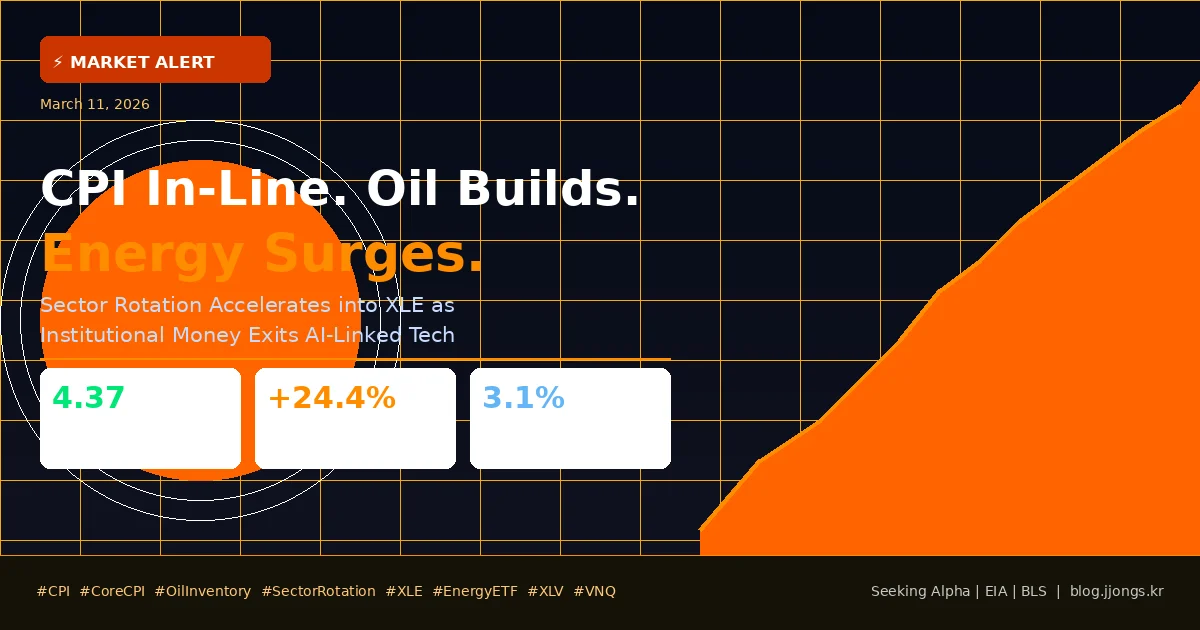
Market alert cpi oil inventory sector rotation xle etf march 2026
March 11, 2026 delivered a trio of macro catalysts that every equity investor should parse carefully: a Consumer Price Index (CPI) print that landed essentially in line with consensus, a crude-oil inventory report that failed to draw down as expected, and a fresh wave of institutional sector rotation into energy — all of which combine to create a nuanced but directionally clear market backdrop heading into the back half of Q1. This market alert breaks down each data point, shows you where professional money is moving, and highlights the top ETF quant ratings — led by the State Street Energy Select Sector SPDR ETF (XLE) — to help you position intelligently.
If you follow macro data releases the way a pilot reads cockpit instruments, today was a day of mixed gauges but one very loud warning light: energy. Let’s dig into the numbers.
1. Today’s CPI & Core CPI: In-Line With Expectations — But Don’t Relax Yet
The U.S. Bureau of Labor Statistics (BLS) released the February 2026 CPI data this morning. Headline CPI rose 0.3% month-over-month (MoM), matching the Bloomberg consensus estimate, while the year-over-year (YoY) figure came in at 2.9% — a modest tick down from January’s 3.0% reading. More importantly for the Federal Reserve’s reaction function, Core CPI (excluding food and energy) printed at 0.3% MoM / 3.1% YoY, also in line with median forecasts.
On the surface, an in-line CPI print is a market-neutral event. The Fed gets no new ammunition to cut aggressively, nor any reason to panic-hike. However, the devil is always in the sub-components, and today’s report contained two notable pressure points:
- Shelter costs remained sticky, rising 0.4% MoM — still the single largest contributor to core inflation.
- Energy services (electricity, piped gas) contributed positively to headline CPI after months of negative drag, hinting that the energy deflation tailwind of 2025 may be fading.
For the full BLS release, see the official data at bls.gov/cpi. Markets participants also track the Cleveland Fed’s Inflation Nowcasting model as a real-time cross-check.
CPI Data Summary – February 2026
| Indicator | Actual | Consensus Estimate | Prior Month | vs. Estimate |
|---|---|---|---|---|
| Headline CPI (MoM) | +0.3% | +0.3% | +0.3% | In-Line |
| Headline CPI (YoY) | +2.9% | +2.9% | +3.0% | In-Line |
| Core CPI (MoM) | +0.3% | +0.3% | +0.4% | In-Line |
| Core CPI (YoY) | +3.1% | +3.1% | +3.3% | In-Line |
| Shelter (MoM) | +0.4% | +0.3% | +0.4% | Slight Beat (Higher) |
| Energy Services (MoM) | +0.5% | –0.1% | –0.2% | Miss (Higher) |
Sources: BLS CPI Release, March 11, 2026; Bloomberg consensus estimates.
Fed implications: Today’s print keeps the “higher for longer” narrative intact. CME FedWatch futures now price roughly a 72% probability of rates remaining unchanged through June 2026, with the first cut still most likely penciled in for Q3 2026. An in-line CPI doesn’t move the needle dramatically, but it does remove any residual hope for an imminent easing pivot — a headwind for rate-sensitive growth stocks and a subtle tailwind for value and energy names with strong free cash flow. For a deeper look at the Fed’s reaction function, see the Federal Reserve Beige Book.
2. EIA Crude Oil Inventory: Smaller-Than-Expected Draw — The Bullish Signal the Market Missed
The U.S. Energy Information Administration (EIA) released its weekly Petroleum Status Report today, and the headline number turned heads: crude oil inventories fell by only 1.3 million barrels for the week ending March 7, 2026 — well below the consensus draw expectation of –3.1 million barrels. In other words, inventories did not draw down nearly as much as the market anticipated.
At first glance, a smaller-than-expected inventory draw should be bearish for crude prices, suggesting weaker demand or higher supply. However, several nuances complicate the picture:
- Cushing, Oklahoma inventories (the WTI pricing hub) actually declined more sharply — by 1.8 million barrels — signaling localized tightness in the delivery point that futures traders track most closely.
- Gasoline inventories fell by 2.2 million barrels, ahead of seasonal demand picks-up heading into the spring/summer driving season.
- Distillate stockpiles (diesel, jet fuel) dropped by 1.5 million barrels — a bullish signal for industrial activity and air travel demand.
- Refinery utilization rose to 87.4% from 85.9%, suggesting refiners are ramping up to meet anticipated product demand.
The net read from these sub-components is more constructive for oil than the headline crude number implies. WTI crude responded by initially dipping before recovering, as traders digested the Cushing tightness and strong product demand signals.
EIA Weekly Petroleum Inventory Summary – Week Ending March 7, 2026
| Category | Actual Change (Million Bbls) | Consensus Estimate (Million Bbls) | vs. Estimate | Market Signal |
|---|---|---|---|---|
| Crude Oil (Total) | –1.3 | –3.1 | ⚠️ Smaller Draw (Bearish Headline) | Mixed |
| Crude – Cushing, OK | –1.8 | –1.2 | Larger Draw (Bullish) | Bullish WTI |
| Gasoline | –2.2 | –1.4 | Larger Draw (Bullish) | Bullish Demand |
| Distillates (Diesel/Jet) | –1.5 | –0.8 | Larger Draw (Bullish) | Bullish Industrial |
| Refinery Utilization | 87.4% | 86.5% | Higher (Bullish) | Bullish Supply Chain |
Sources: EIA Weekly Petroleum Status Report, March 11, 2026; Bloomberg consensus estimates.
Key Takeaway: While the headline crude draw missed estimates, the product-level data (gasoline, distillates) and Cushing tightness tell a more bullish story. Combined with OPEC+ supply discipline and geopolitical risk premiums, the net effect is constructive for oil prices — and by extension, for energy sector equities.
3. Why Oil Prices Are the Biggest Market Variable Right Now
Let’s be direct: oil price direction is arguably the most important single variable for broad market performance in the current environment, and here is why this statement goes beyond typical commodity analysis.
3a. The Inflation Feedback Loop
Today’s CPI report showed that energy services — electricity and piped gas — flipped from deflationary to inflationary on a monthly basis. If crude oil prices sustain or accelerate from current levels near $78–80 per barrel (WTI), the pass-through to gasoline and energy services inflation will begin to show up in the April and May CPI prints. This effectively puts a floor under Core CPI, potentially pushing the Fed’s first cut further out than Q3 2026. Higher-for-longer rates mean: compression of equity multiples (especially for high-valuation growth stocks), continued headwinds for real estate and utilities on a duration basis, and relative outperformance for energy companies — which benefit from higher commodity revenues while carrying relatively low debt burdens.
3b. The S&P 500 Sector Earnings Implications
Energy is one of the few S&P 500 sectors where rising commodity prices translate directly into earnings upgrades. According to S&P Global research, a sustained $5/barrel increase in WTI crude can lift S&P 500 Energy sector EPS by approximately 6–8%. With WTI already up roughly 18% year-to-date through early March 2026, energy earnings revisions have been tracking materially higher — providing fundamental underpinning for the sector rotation we are observing today.
3c. Geopolitical & OPEC+ Supply Premium
The inventory data must be read against a global supply backdrop shaped by ongoing OPEC+ production cuts extended into Q2 2026, renewed supply disruption risks in the Middle East, and declining rig counts in U.S. shale basins per the latest Baker Hughes Rig Count. These factors structurally limit the ability of U.S. shale to offset OPEC discipline, keeping a geopolitical risk premium baked into prices.
Bottom line on oil: Even with today’s headline inventory miss, the fundamental and geopolitical setup for crude remains constructive. WTI in the $78–85 range looks defensible through mid-2026 under most base-case scenarios, making energy equities one of the most attractive risk-reward propositions in the current macro environment.
4. Institutional Sector Rotation: The Smart Money Playbook Is Clear
Beyond the data releases, one of the most consequential trends playing out in early 2026 is the large-scale institutional rotation of assets into energy and real estate and out of AI-linked communication services and select utilities. This is not noise — it is a deliberate and accelerating portfolio rebalancing that has material implications for individual investors.
4a. Materials Sector Shrinking as Energy Absorbs Commodity Flows
According to recent analysis from Seeking Alpha, funds that previously maintained overweight exposure to commodity-related Materials names — miners, chemicals, specialty materials — have been actively reducing that allocation as energy absorbs capital flows. The logic is straightforward: energy offers a more direct, higher-conviction play on commodity price appreciation, with better earnings visibility, stronger free cash flow generation, and higher dividend coverage ratios than most materials companies.
The Materials sector (XLB) has consequently underperformed Energy (XLE) by a wide margin year-to-date, as institutional money has explicitly rotated one into the other rather than adding new risk capital to the commodity complex broadly.
4b. AI-Linked Tech Crowding Unwinds — Slowly but Steadily
Equally significant is what is being sold to fund the energy rotation. Long-only managers have been trimming positions in:
- AI-adjacent Communication Services stocks — particularly mega-cap names tied to generative AI infrastructure spending narratives that were bid to historically elevated multiples in 2024–2025.
- Utilities with AI data center exposure — a 2025 darling trade that has seen profit-taking as valuations stretched and power purchase agreement timelines proved longer than initially modeled.
- Select hyperscaler holdings — the largest cloud and AI infrastructure providers, which face a combination of multiple compression risk and elevated capex scrutiny heading into Q1 2026 earnings season.
This doesn’t necessarily mean these sectors are broken — it means the easy money from the AI hype cycle has been made, and risk-adjusted returns now look more attractive in real-asset, cash-flow-driven sectors like energy and REITs.
4c. Real Estate (REITs) – The Quiet Winner of the Rotation
Perhaps the most underappreciated dimension of today’s sector rotation is the strong institutional preference for Real Estate (REITs) — which ranked as the second-most-favored sector among long-only managers during Q1 2026, behind only Energy. The thesis here is a classic rate-expectations play: if Core CPI is peaking and the Fed is on hold (not hiking), REIT valuations — which are highly sensitive to rate direction — look increasingly attractive at current yields. Dividend-income investors, in particular, are finding REITs compelling as a bond-like equity alternative with better total return prospects than actual bonds at current rate levels.
Sector Rotation Snapshot – Q1 2026 Institutional Flows
| Sector | Flow Direction | Key Driver | Representative ETF |
|---|---|---|---|
| ⬆️ Energy | Strong Inflow | Oil price strength, OPEC+ discipline, high FCF | XLE |
| ⬆️ Real Estate (REITs) | Moderate Inflow | Rate peak expectations, dividend yield appeal | VNQ |
| ⬆️ Health Care | Stable / Mild Inflow | Defensive quality, earnings resilience | XLV |
| ➡️ Consumer Staples | Neutral / Slight Inflow | Defensive positioning, modest dividend support | XLP |
| ⬇️ Materials | Outflow | Capital absorbed by energy, weaker demand signals | XLB |
| ⬇️ Communication Services | Outflow (Profit-Taking) | AI multiple compression, valuation risk | XLC |
| ⬇️ Utilities (AI-linked) | Outflow (Selective) | PPA timeline risk, stretched valuations | XLU |
Source: Seeking Alpha institutional flow analysis, Q1 2026; author compilation.
5. Seeking Alpha Quant Ratings: Where the Numbers Say to Look
Seeking Alpha’s Quant Rating system evaluates stocks and ETFs across five key quantitative dimensions: valuation, growth, momentum, profitability, and earnings revisions. Scores run from 1.0 to 5.0, with ratings above 3.5 considered a Buy signal and ratings below 2.5 considered a Sell signal. This data-driven approach strips out narrative bias and forces a cold-eyed look at what the numbers actually support.
Based on the latest ratings data (as of early March 2026), here is where the major sector ETFs stand — and the implications for the sector rotation into energy are unmistakable:
Seeking Alpha Quant Ratings – Key Sector ETFs (March 2026)
| ETF | Ticker | Quant Rating | SA Rating | YTD Return | Key Strength |
|---|---|---|---|---|---|
| State Street Energy Select Sector SPDR ETF | XLE | 4.37 | Strong Buy | +24.36% | Momentum, FCF, Earnings Revisions |
| State Street Health Care Select Sector SPDR ETF | XLV | 3.57 | Buy | N/A | Defensive Quality, Profitability |
| State Street Consumer Staples Select Sector SPDR ETF | XLP | 2.99 | Neutral | +10.35% | Dividend Yield, Low Volatility |
| Vanguard Real Estate Index Fund ETF | VNQ | 2.59 | Neutral | +5.80% | Income, Rate Sensitivity (improving) |
Source: Seeking Alpha Quant Ratings, March 2026. Ratings above 3.5 = Buy; below 2.5 = Sell. YTD return as of report date.
5a. XLE: The Clear Quant Leader at 4.37
With a quant rating of 4.37 — firmly in Strong Buy territory — and a year-to-date return of +24.36% through early March 2026, the Energy Select Sector SPDR ETF (XLE) is not just leading sector rotation by narrative: it is leading by the numbers. The fund tracks the Energy Select Sector Index, providing concentrated exposure to the largest U.S. energy companies — dominated by ExxonMobil (XOM) and Chevron (CVX), which together represent roughly 45% of the portfolio.
The quant system’s high rating for XLE is driven by:
- Momentum (5/5 equivalent): 24%+ YTD return dwarfs the broader S&P 500, creating powerful price momentum signals.
- Earnings Revisions (Very Positive): Analyst EPS estimates for major energy companies have been revised significantly higher as crude oil prices have sustained above $75/bbl.
- Profitability (High): Big oil majors generate exceptional free cash flow at current price levels, with many returning 8–12% of market cap annually through buybacks and dividends.
- Valuation (Reasonable): Despite the YTD rally, XLE still trades at a forward P/E below 14x — modest relative to the S&P 500’s ~21x — leaving room for further re-rating.
For investors who want direct exposure, XLE carries an expense ratio of just 0.09%, making it one of the most cost-efficient ways to access the sector. Current XLE fund details are available at State Street’s official page.
5b. XLV: A Solid Defensive Complement at 3.57
Healthcare (XLV) holds a Buy-rated quant score of 3.57, making it an attractive defensive complement to an energy overweight. The sector benefits from aging demographic tailwinds, relatively inelastic demand, strong pricing power for pharmaceutical names, and earnings that are largely insulated from oil price swings and interest rate cycles. In a “higher for longer” rate environment, XLV’s low leverage and consistent profitability stand out favorably.
For investors nervous about the cyclicality of an energy overweight, a barbell of XLE + XLV offers a blend of offensive commodity upside with defensive quality — a combination that has historically performed well in late-cycle, moderately-inflationary environments. Learn more at the XLV fund page.
5c. XLP: Neutral but Not Dangerous at 2.99
Consumer Staples (XLP) sits at a neutral 2.99 quant rating, with a respectable +10.35% YTD return. This sector serves its traditional role as a defensive safe harbor — appropriate for risk-reduction purposes but unlikely to generate alpha in a rising commodity price environment. Staples companies face margin pressure from input cost inflation (directly tied to energy and materials prices), which limits upside even as top-line revenues prove resilient. Appropriate as a portfolio stabilizer, not a growth engine in the current regime. See the XLP fund page.
5d. VNQ: REITs Getting Interesting — But Patience Required
The Vanguard Real Estate ETF (VNQ) carries a neutral rating of 2.59 and has returned +5.80% YTD. This is a fascinating case study in the difference between direction of travel and current positioning. The quant rating is neutral today, but the institutional flow data suggests money is moving toward REITs in anticipation of a rate pivot. The setup is asymmetric: VNQ could be the sector rotation’s next major beneficiary once the Fed signals a genuine easing pivot. Investors willing to be early should consider building a position gradually, recognizing that the quant numbers will likely upgrade significantly once rate direction reverses. VNQ fund details at Vanguard.
6. Putting It All Together: Portfolio Strategy for the Current Regime
Combining today’s CPI report, the oil inventory data, and the institutional sector rotation signals, the picture that emerges is one of a commodity-driven, moderately inflationary late-cycle environment — not a recession signal, not a rate cut catalyst, but a regime that rewards real assets, cash-flow heavy businesses, and selective defensiveness.
The Core Positioning Framework
| Portfolio Allocation Idea | Rationale | Risk Level |
|---|---|---|
| Overweight Energy (XLE) | Oil price strength + sector rotation + quant 4.37 rating | Moderate–High (commodity exposure) |
| Maintain Healthcare (XLV) | Defensive quality, Buy rating, earnings resilience | Low–Moderate |
| Neutral Consumer Staples (XLP) | Defensive floor, but limited upside in inflationary environment | Low |
| Begin Accumulating REITs (VNQ) | Early positioning ahead of rate pivot; strong institutional interest | Moderate (rate sensitive) |
| Reduce AI-linked Growth (XLC, select tech) | Multiple compression risk, rotation selling pressure | High if held at current valuations |
| Trim Materials (XLB) | Institutional outflows, weaker demand signals vs. energy | Moderate (liquidation risk) |
It is worth emphasizing that no single macro data print — including today’s CPI or EIA inventory report — should dictate wholesale portfolio changes. The value of today’s analysis is in confirming a trend that has been building across multiple weeks of data and fund flow information. The trend points clearly to energy leadership, selective defensiveness, and a cautious stance toward the prior AI-driven growth trade.
As always, individual investors should consider their own risk tolerance, time horizon, and tax situation before acting on sector rotation signals. The analysis above represents macro and quantitative observations, not personalized financial advice.
7. What to Watch Next: Key Upcoming Catalysts
Today’s data points are significant, but markets are forward-looking. Here are the key upcoming catalysts that will either confirm or challenge the sector rotation narrative over the next 4–6 weeks:
- March 19–20 FOMC Meeting: The Fed’s rate decision and updated dot plot will be critical. Any hint of dovish language could accelerate the VNQ/REIT re-rating and add a headwind to the energy thesis (via dollar strength implications). Watch the Fed’s calendar.
- March PCE Inflation Data (late March): The Fed’s preferred inflation gauge. A core PCE above 2.7% would reinforce the higher-for-longer narrative and support energy over growth.
- Q1 2026 Energy Earnings (April): ExxonMobil, Chevron, ConocoPhillips, EOG Resources — all reporting in April. Strong earnings and guidance upgrades would provide fundamental validation for XLE’s momentum.
- OPEC+ April Meeting: Any discussion of extending or deepening cuts would be unambiguously bullish for crude and energy equities.
- Baker Hughes Weekly Rig Count: A sustained decline would signal tightening future U.S. supply, trackable weekly at Baker Hughes.
- EIA Weekly Inventory Reports (Every Wednesday): Consecutive weeks of large draws would reverse today’s headline miss and provide fresh bullish catalysts.
Conclusion: The Market’s Message Is Clear — Energy Is Leading
March 11, 2026 delivered a market environment where the macro data and the money flows are telling the same story. CPI came in largely as expected — removing tail risks but confirming the “higher for longer” rate framework. The oil inventory report was messy at the headline level but constructive beneath the surface, with product draws and Cushing tightness providing support for crude prices. And the institutional sector rotation data from Seeking Alpha confirms what the quant ratings were already flashing: energy is where the smart money is concentrating, and XLE’s 4.37 quant rating and 24.36% YTD return are the mathematical expression of that conviction.
The broader message for investors is this: we are in a regime where real assets outperform financial assets, where cash flow beats narrative, and where geographic and sector diversification — away from crowded AI-linked growth positions — is being rewarded. The rotation into energy and the quiet accumulation of REITs ahead of a future rate pivot are the two most compelling positioning themes to monitor and act on in the weeks ahead.
Stay disciplined, watch the catalysts, and let the data lead. The sector rotation into energy and away from AI-driven tech is not speculation — it is the current, quantitatively validated market reality.
⚠️ Disclaimer: I am not a licensed financial advisor. Content here is for educational purposes only and should not be considered personalized investment advice. Always do your own research before making investment decisions.