Economic Headwinds : Three Critical Economic Risks from Government Shutdown, China Tariffs, and Rare Earth Supply Crisis
The U.S. stock market faces unprecedented economic headwinds in early 2025. With government shutdown delays to critical economic indicators like CPI data and PPI data, escalating China tariffs at 100%, and retaliatory rare earth export restrictions, investors must prepare for sustained market volatility. This analysis examines the three most significant economic headwinds affecting your portfolio and critical metrics to monitor daily.
The Triple Threat: Three Critical Economic Headwinds Converging
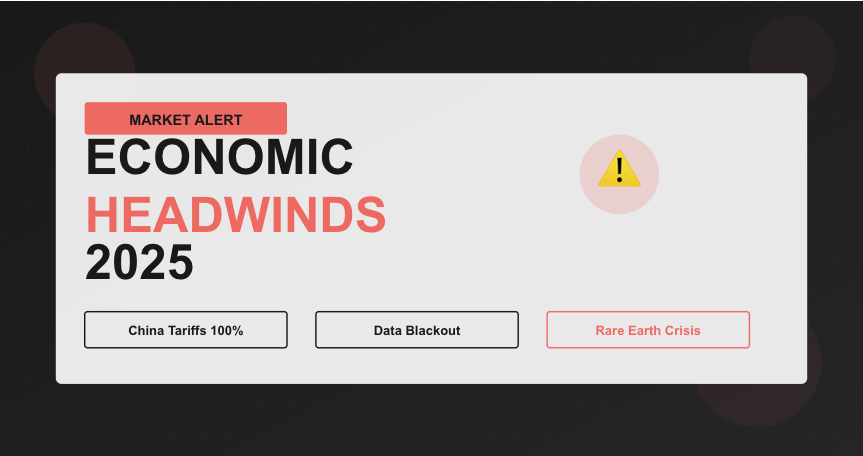
The current economic headwinds environment presents a rare convergence of negative factors that threatens market stability. The ongoing federal government shutdown has created a critical economic data blackout, preventing the release of essential economic indicators including CPI data and PPI data. Simultaneously, President Trump’s announcement of potential 100% China tariffs escalates trade tensions dramatically, while China retaliates with rare earth export restrictions. These three economic headwinds don’t exist independently—they amplify each other, creating cascading risks across all asset classes.
Understanding these economic headwinds is essential for navigating the volatile trading environment ahead. Each individual factor would be significant; their convergence creates what many analysts describe as the worst combination of economic headwinds since 2008.
Economic Headwind #1: Government Shutdown and Critical Data Blackout
The ongoing federal government shutdown represents the most immediate economic headwind affecting market decision-making. The delayed release of crucial economic indicators—particularly CPI data and PPI data—means markets operate in an unprecedented information vacuum. Without these economic headwinds signals, both the Federal Reserve and investors make decisions based on incomplete information.
⚠️ THE DATA BLACKOUT: IMPACT OF DELAYED ECONOMIC INDICATORS
The absence of CPI inflation data and PPI producer price information creates a critical economic headwind for policy decisions. The Federal Reserve cannot accurately assess whether inflation remains sticky or is cooling. This economic headwind directly impacts interest rate expectations, creating wild yield swings across Treasury markets. The longer this economic data blackout persists, the more dangerous the economic headwind becomes for long-term investment planning.
Specific Economic Data Delays Creating Market Headwinds:
- CPI Data Release Delayed: Monthly inflation measurements postponed indefinitely
- PPI Data Postponed: Producer price pressures unknown, inflation trajectory unclear
- Employment Reports at Risk: JobsReport delays create rate expectations chaos
- Retail Sales Data Missing: Consumer spending trends completely unknown
- Housing Starts Reports Delayed: Real estate market direction signals lost
This economic headwind of data uncertainty extends deeper into Q1 2025. Without concrete economic indicators, markets revert to speculation, creating the exact conditions for sharp volatility spikes and whipsaw price action that devastates unprepared investors.
Economic Headwind #2: Trump’s 100% China Tariffs and Trade War Escalation
President Trump’s announcement of potential 100% China tariffs represents an existential threat to global supply chains and represents perhaps the most dangerous economic headwind of 2025. This is not rhetoric—it signals a fundamental reshaping of U.S.-China trade relationships that will reverberate through supply chains globally. The 100% China tariff proposal would essentially double prices on $370 billion of annual Chinese imports, creating massive economic headwinds throughout the entire U.S. economy.
📉 THE 100% TARIFF MATH: HOW THIS ECONOMIC HEADWIND CASCADES
A 100% China tariff effectively doubles import costs instantly. This economic headwind doesn’t just hurt tech manufacturers—it creates inflationary pressure across the entire consumer economy. Electronics, appliances, clothing, vehicles: all contain Chinese components. Your smartphone, laptop, car components—every manufactured good faces tariff-driven price increases. This economic headwind undoes months of Fed efforts to control inflation and threatens to reignite CPI data concerns that had been gradually improving.
Sectors Most Vulnerable to 100% China Tariffs Economic Headwind:
- Technology ETFs: Apple, Qualcomm, Nvidia depend heavily on Chinese manufacturing and components sourcing
- Consumer Discretionary: Retail companies face severe margin compression from escalating tariff costs
- Industrial ETFs: Supply chain disruptions create widespread input cost inflation
- Automotive Sector: EV production heavily reliant on Chinese battery components and rare earth elements
- Electronics Manufacturing: Direct supply chain exposure to China tariffs at 100% rate
Economic Headwind #3: Chinese Retaliation and Rare Earth Supply Crisis
China’s retaliatory measures—particularly announced restrictions on rare earth exports and rare earth element supplies—represent the most underestimated and dangerous economic headwind of 2025. This creates an invisible but devastating chokehold on U.S. manufacturing capacity. The economic headwind from rare earth supply disruptions threatens to cripple American industrial and defense capabilities.
🚨 THE RARE EARTH CHOKEHOLD: CRITICAL SUPPLY CHAIN ECONOMIC HEADWIND
China controls 70% of global rare earth processing and 85% of refining capacity. These rare earth elements are absolutely essential for semiconductors, military weapons systems, renewable energy equipment, and electric vehicle production. A rare earth supply shock means the U.S. cannot easily replace Chinese sources. This economic headwind is catastrophically worse than tariffs alone because it threatens American energy independence and defense capabilities, not just consumer goods. Without rare earth elements, U.S. manufacturing capability faces an existential threat.
Industries Facing Rare Earth Supply Chain Economic Headwinds:
- Defense Contractors: Military electronics dependent on rare earth element components
- Clean Energy ETFs: Wind turbines require permanent magnets containing rare earth elements
- Semiconductor Industry: Advanced chip manufacturing demands rare earth materials
- EV Manufacturers: Motors and battery systems require rare earth element components
- Renewable Energy: Solar panel technology dependent on rare earth processing
How These Three Economic Headwinds Interconnect and Amplify
These three economic headwinds don’t operate independently—they create a dangerous feedback loop that amplifies systemic risk:
The Economic Headwind Cascade:
Data Blackout (CPI/PPI Unknown) → Inflation Uncertainty → Fed Policy Confusion → China Tariffs Announced → Supply Chains Disrupted → Rare Earth Shortage → Inflation Surge → Stock Market Volatility Explodes
This economic headwind cascade means investors face compounding risks. Those who could weather one challenge individually now face the accumulated weight of all three. Market participants who don’t understand this interconnection will be blindsided when these economic headwinds converge into a single, devastating shock.
Critical Watch Areas: Five Economic Headwind Monitoring Zones
📊 MONITORING ZONE #1: CPI AND PPI DATA RELEASES
Why This Economic Headwind Matters: Once the government shutdown ends, delayed CPI data and PPI data releases will hit markets with tremendous force. If inflation proves stickier than expected—likely due to the 100% China tariff economic headwind—the Federal Reserve will be forced to maintain higher rates longer, creating sustained economic headwind pressure on equities.
Specific Economic Data Points to Monitor:
- Core CPI inflation trends (ex-food/energy) and year-over-year changes
- Annual PPI inflation rate and producer price pressures
- Federal Reserve policy statement reactions and forward guidance
- Market repricing of rate cut expectations following data releases
- Treasury yield movements and 2/10 yield curve implications
Action: Set immediate alerts for CPI/PPI releases. This economic headwind creates trading opportunities if prepared. Position defensively before releases; reposition aggressively on outcomes.
⚖️ MONITORING ZONE #2: TARIFF IMPLEMENTATION TIMELINE AND SCOPE
Why This Economic Headwind Matters: The 100% China tariff announcement is still technically a threat, not implemented policy. The actual implementation timeline and scope will determine whether this economic headwind creates manageable disruption or a catastrophic supply chain collapse. Every day of delay represents negotiation opportunity; every implementation announcement represents new market shock.
Specific Economic Data Points to Monitor:
- Official Trump administration tariff announcement dates and percentage rates
- Specific product categories covered under 100% China tariff policy
- Exemption requests and government decisions on rate exceptions
- Corporate earnings guidance revisions due to anticipated tariff costs
- Supply chain manager commentary on sourcing challenges and alternatives
Action: Monitor tech and consumer ETF earnings calls religiously. Companies will discuss China tariff impacts in real-time. This economic headwind gets priced in gradually as implementation details emerge—first movers have advantage.
🔴 MONITORING ZONE #3: RARE EARTH ELEMENT PRICES AND SUPPLY RESTRICTIONS
Why This Economic Headwind Matters: Rare earth supply disruptions are far less visible than tariffs but infinitely more damaging. Watch commodity prices and supply announcements carefully—this economic headwind affects manufacturing capability at its foundation. No rare earth elements means no semiconductors, no military systems, no renewable energy capacity.
Specific Economic Data Points to Monitor:
- Rare earth commodity prices (Neodymium, Dysprosium, Terbium) daily movements
- China export restriction announcements and implementation dates
- U.S. rare earth mining project updates and production timeline acceleration
- Supply chain manager commentary on rare earth sourcing challenges and costs
- Defense department statements on military production capability concerns
Action: Follow defense contractor and clean energy ETF quarterly updates obsessively. This rare earth economic headwind hits supply-constrained industries first. Position before the supply shock becomes mainstream knowledge.
💹 MONITORING ZONE #4: TREASURY YIELDS AND FEDERAL RESERVE RATE EXPECTATIONS
Why This Economic Headwind Matters: The economic headwind from data uncertainty manifests first in bond markets. Treasury yields signal whether the market expects the Federal Reserve to cut, hold, or raise rates—absolutely critical information for all ETF valuations. Rising yields create headwinds for growth stocks; falling yields create headwinds for dividend stocks.
Specific Economic Data Points to Monitor:
- 10-Year Treasury Yield (reflects inflation expectations and growth outlook)
- 2-Year vs 10-Year spread (yield curve steepness or inversion signals)
- Federal Reserve Funds futures pricing (market rate expectations)
- Volatility Index (VIX) for market stress levels and fear indicators
- Real yields (TIPS spread) for inflation expectations on a forward basis
Action: If Treasury yields spike on CPI data release, this economic headwind will pressure growth ETFs severely. Position defensively before data releases; add to growth positions on yield retreats.
🌐 MONITORING ZONE #5: U.S.-CHINA TRADE NEGOTIATIONS AND DE-ESCALATION SIGNALS
Why This Economic Headwind Matters: The 100% China tariff threat is fundamentally a negotiating position. Any credible signal of U.S.-China de-escalation would dramatically reduce this economic headwind and could spark a powerful relief rally across equity markets. Conversely, any hardening of negotiating positions could extend this economic headwind indefinitely.
Specific Economic Data Points to Monitor:
- Official statements from Trump administration on tariff policy direction
- Chinese diplomatic responses and formal counter-offers on trade terms
- Market-moving news from bilateral negotiations and backchannels
- Tariff delay announcements (often precede negotiated deal announcements)
- Third-party mediator statements (industry groups, Republican Congress members)
Action: This economic headwind is most responsive to headlines. Have tactical buy/sell plans ready for any positive trade news. De-escalation is the highest-probability relief to current economic headwind pressure.
Portfolio Strategy During Economic Headwinds Convergence
How should ETF investors position portfolios amid these converging economic headwinds?
Immediate Phase (Next 2-4 Weeks):
Expect elevated market volatility as economic headwind impacts price in aggressively. Consider holding 15-20% cash reserves to deploy during panic-driven dips. Reduce positions in tariff-sensitive sectors (consumer discretionary, technology, semiconductors). This immediate economic headwind phase creates fear-driven selling that rewards patient deployers of capital.
Short-Term Phase (2-3 Months):
Once delayed economic indicators—particularly CPI data and PPI data—finally release, the economic headwind picture becomes clearer. If inflation is cooling despite tariff concerns, markets stabilize quickly. If inflation surges from tariff impacts, expect further market corrections. The Federal Reserve’s messaging post-data becomes absolutely critical.
Medium-Term Phase (6+ Months):
The economic headwind from trade uncertainty becomes either policy-resolved (deal reached) or structural (sustained tariffs become permanent). Long-term ETF investors should ignore short-term noise and maintain disciplined diversification strategies. Those who panic during volatility and lock in losses will regret it once resolution emerges.
💡 CRITICAL TAKEAWAY: The convergence of federal government data blackout, 100% China tariff threats, and rare earth supply restrictions creates a rare “triple economic headwind” environment. Investors who understand these economic headwinds in detail and monitor the five critical watch zones will navigate this period far more successfully than those caught off-guard by cascading shocks.
🚨 ECONOMIC HEADWINDS DEMAND IMMEDIATE ACTION
Don’t allow economic uncertainty to paralyze your investment decisions.
Review your portfolio allocation TODAY in light of these economic headwinds.
Position defensively for volatility. Monitor the five critical zones daily.
Be prepared to act when opportunities emerge from the chaos.
⚠️ Disclaimer: I am not a licensed financial advisor. Content here is for educational purposes only and should not be considered personalized investment advice. Always do your own research before making investment decisions.