Iran Conflict Global Market Impact: Oil, Gold, Shipping & Stocks 2026
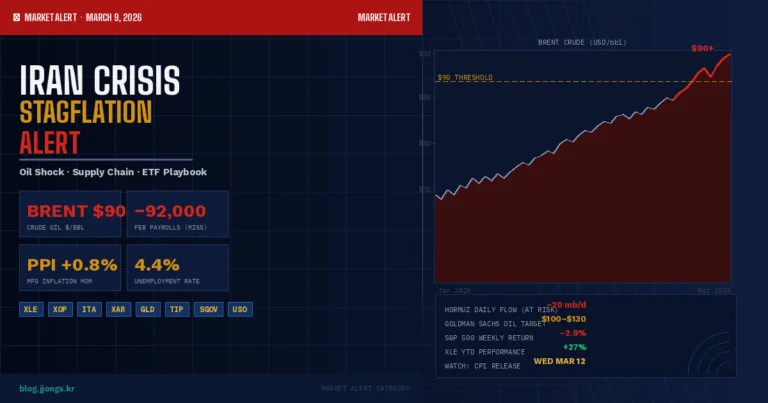
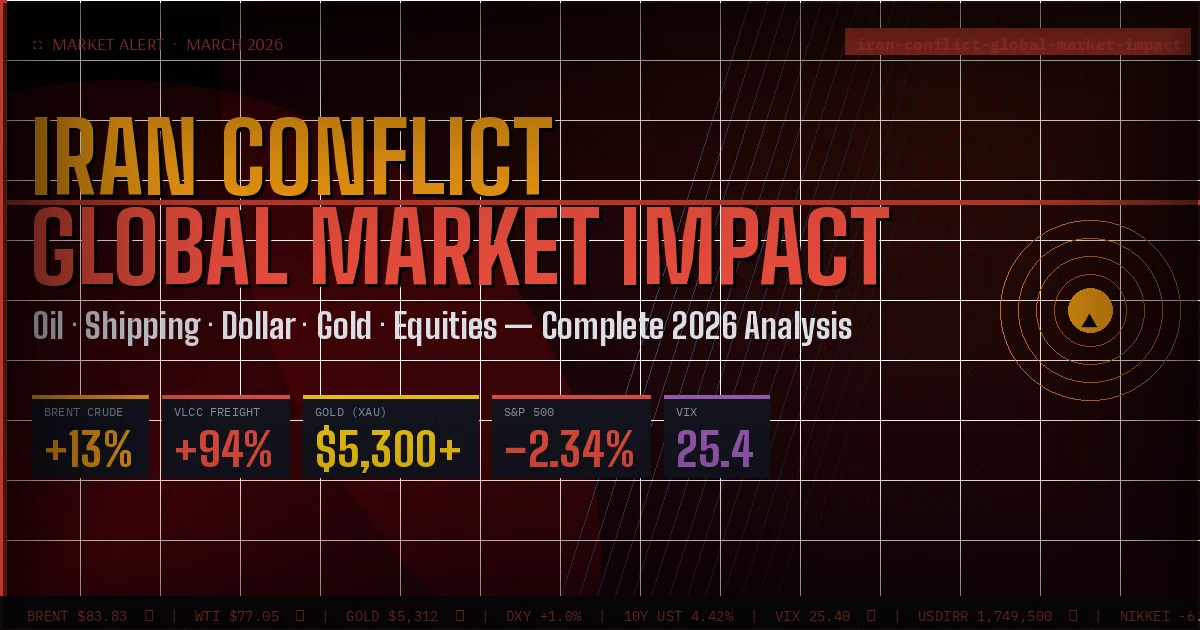
Market Alert — March 2026. The United States and Israel launched coordinated strikes on Iran on February 28, 2026 under “Operation Epic Fury,” killing Supreme Leader Ali Khamenei and triggering the most significant geopolitical market shock since Russia’s invasion of Ukraine in 2022. In the days that followed, Brent crude surged more than 13%, supertanker freight rates hit an all-time record, gold blew past $5,300 per ounce, and the Dow shed over 1,200 points in a single session. The Iran conflict global market impact is still unfolding — and the worst-case scenarios are very much on the table. This post breaks it all down.
1. Oil Price Surge: The Energy Shock at the Center of It All
No factor is more central to the Iran conflict global market impact than crude oil. Iran is OPEC’s fourth-largest producer, pumping just over 3 million barrels per day (bpd). More critically, Iran shares a coastline with the Strait of Hormuz — the world’s single most important energy chokepoint. According to CNBC and energy data firm Kpler, more than 14 million barrels per day flowed through the Strait in 2025, representing roughly one-third of all global seaborne crude exports. About three-quarters of those barrels travel to China, India, Japan, and South Korea.
The moment U.S. and Israeli strikes began on February 28, 2026, oil markets reacted sharply:
- Brent crude surged up to 13% in early trading on March 2, briefly crossing the $83/bbl threshold — a level not seen since mid-2024.
- WTI (West Texas Intermediate) jumped more than 7–9%, with U.S. crude soaring nearly $6 per barrel on the first full trading day.
- By Tuesday, March 3, Brent topped $83.83 and WTI climbed to $77.05 — rises of nearly 8% in a single session, as the Strait of Hormuz de facto closure solidified.
- LNG (Liquefied Natural Gas) prices in Europe surged sharply after QatarEnergy halted production at its Ras Laffan and Mesaieed facilities following Iranian retaliatory strikes.
Historical Precedent: What Past Oil Shocks Tell Us
The playbook for oil-driven market crises is well established. Analysts at JPMorgan, Goldman Sachs, and energy research firm Wood Mackenzie have all drawn comparisons to past events:
- 1973–74 Arab Oil Embargo: OPEC’s embargo on the U.S. and Western Europe caused oil prices to quadruple. The S&P 500 fell nearly 50% over 1973–74, partly attributable to energy cost shock.
- 1979–80 Iranian Revolution: Iranian oil exports collapsed. Global prices doubled within a year, triggering stagflation that plagued the global economy for years.
- 1990–91 Gulf War: Iraq’s invasion of Kuwait sparked an oil price spike of ~150%. Equity markets dropped sharply initially, but recovered within months once the military campaign concluded quickly. The S&P 500 rose 16% in the 12 months following the conflict’s start.
- 2022 Russia–Ukraine War: Brent surged from ~$80 to $128/bbl in weeks. Central banks were forced into aggressive rate hike cycles, contributing to the worst equity bear market in over a decade.
The current Iran situation sits between these precedents in terms of severity — but JPMorgan analysts have warned that four variables will ultimately determine oil’s trajectory: (1) how much supply is disrupted, (2) how long the disruption lasts, (3) whether other producers can fill the gap, and (4) what comes next diplomatically and militarily.
“A prolonged closure of the Strait of Hormuz is a guaranteed global recession.” — Bob McNally, former White House energy advisor & President, Rapidan Energy Group (via CNBC, Feb. 28, 2026)
Key supply risk: OPEC+ retains approximately 3.5 million bpd of spare capacity, concentrated in Saudi Arabia and the UAE — but a significant portion of that capacity cannot reach global markets if the Strait remains inaccessible. Alternative pipeline routes (such as Petroline in Saudi Arabia) can export less than 3 million bpd incrementally, far short of what passes through Hormuz. Energy analysts at CNBC and Kpler have noted this asymmetry as a key reason why the current crisis could prove more severe than initially priced in.
2. Shipping & Freight Rates: The Strait of Hormuz in Crisis
If oil is the headline, shipping freight rates are the mechanism through which the energy shock becomes a global economic contagion. The Strait of Hormuz handles approximately one-third of global seaborne crude oil, 19% of global LNG, and 14% of refined petroleum products, according to Argus Media. A de facto closure doesn’t just affect energy — it disrupts container shipping, supply chains, and manufacturing inputs for economies from Europe to East Asia.
Record-Breaking VLCC Freight Rates
The benchmark freight rate for Very Large Crude Carriers (VLCCs) — supertankers used to haul 2 million barrels of oil from the Middle East to China — hit an all-time high of $423,736 per day on March 2, 2026, according to LSEG data. That marked a staggering 94% jump from Friday’s close in a single session. CNBC reported that major marine war risk insurers had begun scrapping coverage for vessels in the Persian Gulf entirely, leaving shipowners unable to transit even if they wanted to.
Key shipping developments as of March 3–4, 2026:
- Strait of Hormuz transits collapsed 81% between Sunday March 1 and Sunday February 22 (vs. the January average), per Lloyd’s List vessel tracking data.
- Approximately 150 ships are stranded around the Strait. At least 5 tankers have been damaged; 2 crew members killed.
- LNG freight rates jumped more than 40% in a single day after Qatar halted LNG production. Atlantic LNG shipping rates hit $61,500/day (up 43%); Pacific rates rose to $41,000/day (up 45%), per Spark Commodities. Wood Mackenzie’s Fraser Carson warned spot LNG rates could exceed $100,000/day.
- Hapag-Lloyd introduced a War Risk Surcharge (WRS) of $1,500 per TEU for standard containers to/from the Arabian Gulf. Maersk suspended special cargo acceptance in and out of the UAE.
- War risk insurance will effectively expire at midnight March 5 unless shipowners renegotiate at vastly inflated premiums. (Lloyd’s List)
The Double-Whammy: Hormuz + Red Sea
Freight analyst Peter Sand at Xeneta noted to The National that the current situation is potentially “a double whammy.” Shipping lines had been tentatively returning to Red Sea/Suez Canal routes after the Houthi disruptions of 2023–2025, but with the Iran conflict reigniting Houthi threat calculus, those routes are again being avoided. Ships rerouting around the Cape of Good Hope add 10–14 days to voyages, significantly tightening global container capacity and pushing freight rates higher on all routes — not just those through the Gulf.
Historically, supply chain disruptions of this magnitude (2021 post-COVID shipping chaos, 2022 Ukraine war, 2023–24 Red Sea rerouting) have added 0.5–1.5 percentage points to consumer price inflation over 6–12 months.
3. U.S. Dollar: Safe Haven or Inflation Casualty?
The U.S. dollar’s behavior in this crisis has been nuanced — and that complexity matters for investors. The U.S. Dollar Index (DXY) rose 1% in the immediate aftermath of the strikes, as risk-off sentiment drove global capital into the traditional dollar safe haven. However, FX analysts at FX Empire and Standard Chartered noted that the underlying picture is more complex.
Standard Chartered’s Global Head of Research Eric Robertsen observed that the dollar was “only modestly weaker year-to-date” coming into the crisis, but that beneath the surface, commodity-linked currencies had been outperforming — suggesting markets were already pricing for a terms-of-trade advantage in resource-rich economies. (CNBC)
Two-Phase Dollar Dynamics
FX analysts describe a two-phase dynamic playing out:
- Phase 1 — Immediate fear-driven flows (risk-off): Dollar strengthens as global investors flee to safety. Safe-haven currencies (Swiss franc, Japanese yen) also benefit. The Iranian Rial collapsed to a record low of 1,749,500 per USD — a 30% drop from January 2026 — underscoring the asymmetric impact on adversary currencies.
- Phase 2 — Energy price adjustment: As the U.S. is now a net energy exporter (the world’s largest oil producer), sustained high oil prices are ultimately beneficial for the U.S. current account. This can drive further dollar strength — but simultaneously, higher energy import costs for Europe and Asia weaken the euro, yen, and Korean won against the dollar.
The key risk for the dollar is inflation reacceleration. If oil prices remain elevated, it could complicate the Federal Reserve’s rate-cutting path, forcing a “higher for longer” posture that markets had already begun to price in. U.S. Treasury yields initially dipped (safe-haven bond buying) but subsequently began rising as the inflationary implications of sustained oil above $80 were digested — a pattern noted by Julius Baer analysts as “telling” of the bond market’s read on the situation. (Julius Baer)
4. Gold: The Undisputed Safe-Haven Winner
Of all the assets affected by the Iran conflict global market impact, gold has been the clearest beneficiary. Gold futures jumped more than 2% — over $100 per ounce — in immediate response to the strikes, with investors and institutions moving aggressively into the metal as a store of value amid extreme uncertainty.
By March 2, 2026, gold had surged to a new all-time high above $5,300 per ounce, a single-session gain of $200+. The precious metal was up 24% year-to-date as of early March, vastly outperforming the S&P 500’s meager 0.5% YTD gain. On crypto exchange Hyperliquid (which trades 24/7), perpetual futures tied to gold rose roughly 1.2% to $5,334/oz in the hours after the initial strikes began on Saturday. (CNBC)
Price Targets & Historical Context
JPMorgan has raised its gold price target to $6,300 per ounce by December 2026, reflecting analyst confidence that demand for the metal will remain structurally elevated. Goldman Sachs and Seeking Alpha macro analysts similarly highlighted gold as the “clear beneficiary” of the crisis, with several naming it a high-conviction long during the uncertainty. (Seeking Alpha — Iran Escalation: Oil Shock, Gold Surge, Equity Risk)
Historically, gold’s behavior in geopolitical crises follows a pattern: an initial sharp spike driven by speculative futures activity, followed by partial consolidation — unless the crisis is sustained and accompanied by inflation. Julius Baer’s analysis of prior conflicts noted that “gold’s temporary rise” has often been driven by futures speculators rather than lasting physical safe-haven demand. However, the firm cautioned that the inflationary channel — if oil stays elevated — could provide a more durable floor for gold prices than in previous geopolitical shock episodes.
Gold-linked equities also surged: gold mining stocks across the board rose 3–6% in early March, while ETFs such as GLD, GDMN, and GLTR attracted heavy inflows.
5. Stock Market Impact & Sector Rotation
Equity markets have been in a volatile, whipsaw mode since the conflict began. The initial response illustrated a classic geopolitical risk playbook — but this time with key differences that make the Iran conflict more market-relevant than most recent shocks.
Index Performance (Feb. 28 – March 3, 2026)
| Index | Change (Conflict Period) | Notable Session |
|---|---|---|
| S&P 500 | −2.34% (March 3 close) | Down as much as −2.5% intraday |
| Dow Jones | −2.48% | Down 1,200 pts intraday on March 2 |
| Nasdaq 100 | −2.41% | Software ETF (IGV) bucked trend, +1.5% |
| Russell 2000 | −3.71% | Hardest hit U.S. index; domestic exposure |
| FTSE 100 | −3.59% | Energy weighting provided some buffer |
| Nikkei 225 | −6.65% | Japan is acutely exposed as energy importer |
| VIX (Fear Index) | Rose to 25.40 | Significant spike from pre-conflict ~17 |
Sector Winners and Losers
Not all sectors moved in the same direction. The Iran conflict global market impact has triggered a significant rotation:
🟢 Sector Winners:
- Energy stocks: Exxon Mobil, Chevron, Shell, BP surged 3–5% as oil prices spiked. This is the most direct beneficiary of supply disruption risk premiums.
- Defense & aerospace: Lockheed Martin, Northrop Grumman, RTX (Raytheon) rose 2–3%. Palantir Technologies saw its price target raised from $150 to $200 by Rosenblatt, citing growing defense-AI relevance. (Rolling Out)
- Gold mining stocks: Broad rally of 3–6% across the sector.
- Software stocks (paradoxically): The iShares Expanded Tech-Software Sector ETF (IGV) gained ~1.5% on March 2, as investors rotated into cash-rich, domestically-insulated tech names as a defensive play within growth.
🔴 Sector Losers:
- Airlines: United Airlines, American Airlines, Ryanair fell 4–8%, hit by fuel cost surge and airspace closures. Over 1,800 flights in/out of Middle East countries were canceled on March 1 alone (Cirium data). Travel chaos spread as far as Brazil and Australia.
- Cruise operators: Carnival tumbled ~6% on March 3 (after already shedding 7.6% on March 2). Norwegian Cruise Lines dropped ~6%, adding to a 10.5% loss the prior session.
- Small-cap stocks: Russell 2000 took outsized hits; individual small-caps fell 10–20% in some cases.
- Semiconductor equipment: Applied Materials, Lam Research, KLA, ASML all fell more than 6%, as global supply-chain and demand concerns resurfaced.
- Consumer discretionary: Retail and leisure sectors facing both inflation-from-energy and consumer confidence erosion.
Historical Geopolitical Market Patterns
Carson Group’s Ryan Detrick analyzed 40 major geopolitical events across 85 years and found the S&P 500 lost on average just 0.9% in the first month following such events, but rose 3.4% over the subsequent six months. Barclays’ trading desk data going back to 1980 showed the S&P 500 was on average unchanged the day after a geopolitical shock, with recovery typically within a month. (CNN Business)
However, AlphaCore Wealth Advisory’s Stubbs cautioned: “If there’s going to be a wider conflict and a longer disruption, then eventually parts of the equity market will start to pay attention.” The key differentiator is duration. A one-month conflict is manageable; a prolonged war with Hormuz disruption is not.
6. Worst-Case Scenarios: What Top Analysts Are Projecting
If nuclear negotiations fail permanently, the conflict becomes protracted, or — most critically — if ground troops are deployed and the Strait of Hormuz remains closed for weeks to months, the economic downside projections are severe. Here is what the most influential financial institutions and analysts are projecting:
🏦 Goldman Sachs
Goldman Sachs strategist Dominic Wilson wrote in a client note that equities will be affected mainly if the oil shock proves “severe and sustained” — comparable to 1990 (Gulf War) or 2022 (Ukraine). Cyclical sectors tied to global trade would bear the brunt. Goldman cut top-line and operating profit estimates across 2026–2030 by approximately 6% and 10% respectively for energy-exposed companies in a prolonged scenario. Their S&P 500 base target remains 7,500 by year-end 2026, but a sustained Hormuz closure could force a significant downward revision.
📎 CNBC — S&P 500 Live Updates, March 1–2, 2026
🏦 JPMorgan Chase
JPMorgan analysts published a Sunday note laying out four oil-price variables (disruption magnitude, duration, alternative supply availability, diplomatic outcome). They agreed with Wood Mackenzie that the conflict could push oil above $100/bbl if Hormuz remains blocked. In a worst-case scenario: S&P 500 could drop to 6,000 from ~6,850 current levels — a drawdown of ~12.4%. JPMorgan raised gold target to $6,300/oz by December 2026.
📎 Fortune — Stocks Global Selloff, March 2, 2026
🏦 Wells Fargo
Wells Fargo’s Ohsung Kwon noted historical precedent: S&P 500 rose 16% and 14% in the 12 months following the First and Second Gulf Wars respectively, and the index was “largely flat during the military buildup.” Base case: S&P 500 reaches 7,500 by year-end. Tail-risk worst case: prolonged supply disruption could mirror the 2022 Ukraine energy shock, which saw S&P 500 fall ~25% peak-to-trough. Kwon recommended buying the dip for the base case.
📎 Fortune — Wall Street Iran Response Analysis
🏦 Natixis (Alicia García-Herrero, Asia-Pacific Chief Economist)
Expected “rough and risk-off” open, with global equities potentially down 1–2% or more, U.S. Treasury yields falling 5–10 basis points, and oil jumping 5–10% in the short term. García-Herrero flagged Asia — particularly Japan, India, and South Korea — as facing the acutest energy security risk, given their near-total dependence on Hormuz-routed oil. Advised: “No hero bets” and waiting for clarity on Iran’s response trajectory.
📎 CNBC — Markets Brace for Impact, Feb. 28, 2026
🏦 Allianz Global Investors
AllianzGI laid out four scenarios pre-conflict: (1) non-military negotiations, (2) military action without regime change, (3) regime change, (4) broader regional war. Markets are now navigating between scenarios 2 and 3, with real spillover risk into scenario 4. The firm noted that Khamenei’s death raises the probability of regime change — which, paradoxically, markets may eventually view positively if it leads to a more moderate Iran. However, the transition period carries extreme risk: civil war and/or economic collapse in Iran remain plausible outcomes.
📎 AllianzGI — Strikes on Iran: Assessing the Market Impact
The consensus across these institutions: oil above $100, sustained Strait closure for 4+ weeks, and conflict spreading to encompass ground operations would likely push the global economy into recession — comparable to or worse than the 2022 inflation shock. Energy research firm Kpler’s base case as of March 1 was “conflict lasting at least one week, with partial de-escalation through diplomacy” — but acknowledged the range of outcomes was unusually wide.
7. What to Watch: Key Inflection Points for Investors
For investors trying to navigate the Iran conflict global market impact in real time, these are the specific signals and inflection points that will determine whether this remains a short-term shock or escalates into a prolonged global crisis:
🔑 #1 — Strait of Hormuz Status (Most Critical)
This is the single most important variable. The difference between Brent at $85 and Brent at $120+ is fundamentally a question of whether the Strait reopens within days or weeks. Watch for: (a) IRGC official communication changing stance on Hormuz closure; (b) visible U.S. Navy escort operations beginning (Trump ordered the U.S. Development Finance Corporation to provide shipping insurance and pledged Navy escorts); (c) tanker traffic data from Kpler or Lloyd’s List showing transit volumes recovering above 20% of normal. A full resumption of Hormuz transits is the single most powerful market positive trigger.
🔑 #2 — Iran’s Leadership Transition
The death of Supreme Leader Khamenei has created a genuine power vacuum. Iran has announced a temporary leadership council, but the path forward is murky. Watch for: (a) whether the IRGC consolidates control (more hawkish, escalatory); (b) whether moderate or pragmatic factions gain influence (possible diplomatic opening); (c) signs of internal fracture or civil conflict (worst-case economic disruption scenario). As AllianzGI noted, a regime change toward moderation could ultimately be market-positive — but the transition itself is inherently destabilizing. Ben Emons of FedWatch Advisors flagged “regime-change tail risks” as leaving an “uncertain endgame.”
🔑 #3 — OPEC+ Emergency Response
On March 1, eight OPEC+ members announced plans to increase output by 200,000+ bpd. Watch for: (a) whether Saudi Arabia and UAE can actually deliver incremental supply via alternative pipeline routes (Petroline, ADCO Abu Dhabi onshore fields); (b) whether OPEC+ calls an emergency meeting to formally cap price damage; (c) whether Gulf states themselves (whose energy infrastructure was targeted in Iranian retaliatory strikes) remain politically and operationally capable of ramping production. If OPEC+ cannot credibly offset supply disruption, the $100/bbl scenario accelerates.
🔑 #4 — Nuclear Negotiation Signals
The current conflict grew out of failed nuclear negotiations in Geneva and a prior 12-day air conflict in 2025 (per Wikipedia’s conflict timeline). Watch for: (a) any back-channel diplomatic communication involving Qatar, Oman, Turkey, or China — all of whom have maintained relationships with Tehran; (b) whether Iran’s new leadership signals willingness to re-engage on nuclear talks as a path to ceasefire; (c) U.S. diplomatic posture — Trump’s statements have swung between “weeks-long conflict” and Navy escort pledges, suggesting internal deliberation on end-state. A credible negotiation path is the most powerful de-escalation signal.
🔑 #5 — Fed & Central Bank Response to Inflation Pressure
If oil stays above $80–$85 for more than 4–6 weeks, inflation expectations will re-price materially higher. Watch for: (a) Fed communications at the March/April FOMC meetings — any signal that rate cuts are being pushed back will hit growth stocks hard; (b) European Central Bank and Bank of Japan responses to their more acute energy import exposure; (c) breakeven inflation rates in TIPS markets (5-year, 10-year) — if these move above 2.8–3.0%, the equity market’s valuation compression risk escalates significantly.
🔑 #6 — Houthi & Hezbollah Escalation
The conflict has already widened to Lebanon (Hezbollah fired missiles/drones into Israel on March 3). Yemen’s Houthi forces are said to be preparing to close the Bab Al Mandeb strait (the Red Sea chokepoint). If both Hormuz AND Bab Al Mandeb are simultaneously disrupted — as Xeneta’s Peter Sand described the “double whammy” — global freight costs could enter uncharted territory, with cascading supply-chain inflation effects across all sectors.
🔑 #7 — S&P 500 Technical Levels
From a pure market mechanics standpoint, Seeking Alpha’s Andrew McElroy (Matrixtrade) identified 6,764 as the critical support level to watch on the S&P 500. A decisive daily close below this would open the door for a move toward 6,550. The index closed February at 6,878, came within range of the danger zone, then partially recovered. A sustained break below 6,764 is the technical trigger that would shift the market psychology from “buying the dip” to “risk-off regime.” Watch this level daily as Hormuz developments evolve. (Seeking Alpha — S&P 500 Technical Analysis)
8. Bottom Line: Positioning in an Uncertain Geopolitical Landscape
The Iran conflict global market impact is still in its early stages, and the range of outcomes — from a short, contained air campaign resolved in weeks to a prolonged regional war with permanent Hormuz disruption and global recession — remains unusually wide. Here is the framework to guide positioning:
📊 Scenario Framework (as of March 4, 2026)
- Base Case (most likely, ~55%): Conflict lasts 2–6 weeks. Strait partially disrupted. Brent stabilizes $80–$95. S&P 500 ends 2026 near 7,000–7,500. Gold $5,500–$6,000. Fed delays 1–2 cuts.
- Optimistic Case (~20%): Ceasefire/diplomatic breakthrough within 2 weeks. Strait reopens. Oil retraces to $70–$75. S&P 500 recovers to 7,200–7,500 by mid-year.
- Adverse Case (~20%): Conflict extends 2–3 months. Hormuz closed 4+ weeks. Brent reaches $100–$110. S&P 500 falls to 6,200–6,500. Global growth slows sharply.
- Tail Risk Case (~5%): Full regional war, ground troops, permanent Hormuz disruption. Oil $130+. Global recession. S&P 500 drops to 5,500–6,000. Inflation re-accelerates.
The most critical investment insight from Wall Street’s top strategists: patience and liquidity are the priority until the Strait of Hormuz situation resolves one way or another. Energy stocks and gold remain the highest-conviction trades on the long side. Large-cap tech — especially cash-rich AI leaders like Nvidia and Microsoft — has shown surprising resilience, as investors view them as domestically insulated from energy shocks.
What investors and economists universally agree on: this is not a crisis to shrug off. As Standard Chartered’s Robertsen put it, investors had been “underpricing geopolitical risk” for months. The Iran conflict has changed that calculus. Whether it produces a temporary market dip or a regime-level economic shock will depend entirely on the next 2–4 weeks of military, diplomatic, and energy market developments.
Stay tuned to this Market Alert category for ongoing updates as the situation develops.
⚠️ Disclaimer: I am not a licensed financial advisor. Content here is for educational purposes only and should not be considered personalized investment advice. Always do your own research before making investment decisions.