
Pre-Market Outlook: Government Shutdown Concerns Weigh on Stocks – October 1, 2025
Pre-Market Outlook: Government Shutdown Concerns Weigh on Stocks – October 1, 2025
Good morning, investors. As we approach the opening bell, U.S. stock futures are indicating a cautious start to the trading day. The primary headwind appears to be the increasing likelihood of a government shutdown, adding to existing concerns about interest rate uncertainties and mixed signals from the tech sector.
Main Issue
The looming government shutdown is casting a shadow over the market. Negotiations appear stalled, and the potential for a prolonged shutdown is unnerving investors. This situation introduces uncertainty across various sectors, impacting government contracts, economic data releases, and overall market sentiment.
Background & Analysis
The market has been navigating a complex landscape recently, balancing positive economic data with persistent inflation concerns. The Federal Reserve’s future rate decisions remain a key point of contention, with analysts divided on whether further rate hikes are necessary. Adding to this complexity, the technology sector is showing mixed performance, with some companies outperforming expectations while others struggle. The potential government shutdown amplifies these existing uncertainties, creating a risk-off environment as investors seek safer assets.
Affected Sectors and Key Stocks
A government shutdown would disproportionately affect sectors reliant on government funding and contracts. Defense stocks, such as Lockheed Martin (LMT) and General Dynamics (GD), could face downward pressure. Similarly, companies in the infrastructure and construction sectors may experience delays and reduced revenue. Financial institutions, already facing scrutiny due to recent downgrades and concerns about regional banks, could also see increased volatility. Keep an eye on Wells Fargo (WFC) and U.S. Bancorp (USB), especially after Morgan Stanley’s recent rating adjustments.
Impact & Signal
The immediate impact of a shutdown is likely to be a decrease in investor confidence, leading to a sell-off in equities. The signal this sends is one of caution and risk aversion. Investors may rotate into defensive sectors such as utilities and consumer staples. Furthermore, the shutdown could delay the release of key economic data, making it more difficult to assess the overall health of the economy and potentially impacting future Fed decisions.
Why It Matters for Global Investors
The U.S. government shutdown has ramifications beyond domestic markets. As the world’s largest economy, instability in the U.S. can trigger ripple effects globally. International investors may become more hesitant to invest in U.S. assets, potentially leading to capital outflows and currency fluctuations. Moreover, a prolonged shutdown could impact global trade and economic growth, affecting companies with significant operations in the United States.
What to Watch Next
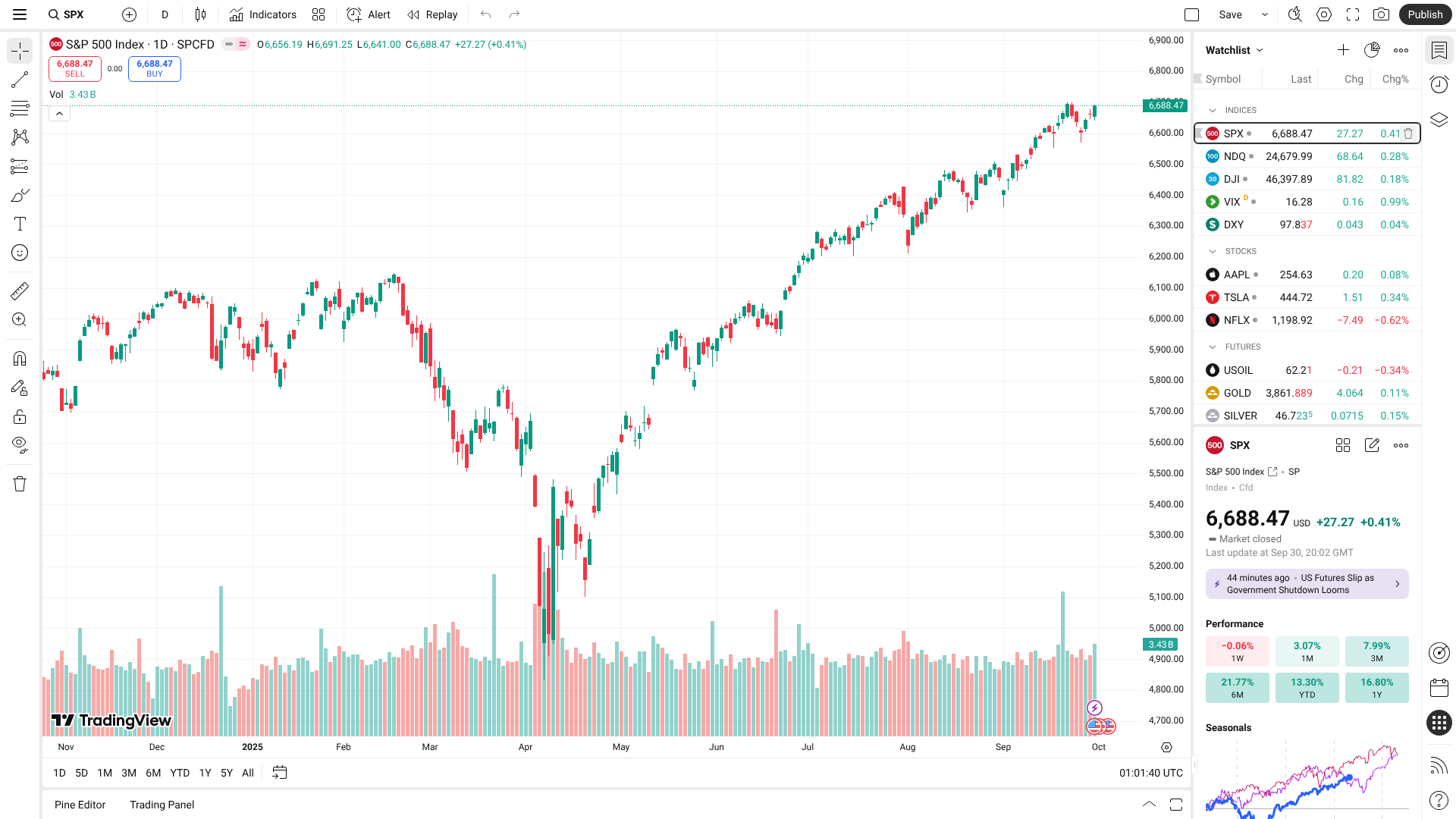
The immediate focus will be on the progress of negotiations in Washington. Any signs of compromise could provide a boost to the market, while a failure to reach an agreement will likely exacerbate the downward pressure. Investors should also monitor economic data releases closely, paying attention to any potential delays or revisions due to the shutdown. Furthermore, keep an eye on oil prices, as OPEC+ considers further production increases, which could impact energy stocks.
Source: TradingView
Supporting Evidence:
- Wall Street slides as a potential government shutdown looms
- SA Asks: What’s the most attractive chip stock right now?
- Tech Voices: Ford CEO on EV market, Cerebras, AI CapEx spending
- Top 5 Income Stocks
- Crude oil adds to losses as OPEC+ said to consider bigger production increase
- Wells Fargo, U.S. Bancorp cut to Equalweight at Morgan Stanley
- Wall Street advances as attention shifts to a potential government shutdown
- Goldman Sachs maintains pro-risk stance as markets continue ‘risk-on’ shift
- Weekly ETF flows: Eight out of 11 sectors record outflows; Gold leads with higher inflows
- Tesla is the ‘OG meme stock’ according to Barclay’s Dan Levy
- Stock market should steadily broaden out in 2026, says Piper Sandler’s Kantrowitz
- 5 Best AI Revolution Stocks With
- Oil slides as OPEC+ seen likely to raise output again, Kurdistan resumes oil flows to Turkey
- Fading the humanoid robot revolution: iRobot’s co-founder issues a warning for investors
- I Could Build My Entire Retirement
- Oil executives bemoan Trump’s energy policy ‘chaos,’ Dallas Fed survey says
- OPEC+ is said to weigh another production hike in November
- Wall Street struggles for traction amid mixed tech stocks, rate-cut uncertainties
- Tech Voices: Waymo, Amazon’s Zoox, airport ransomware update
- EV sales are rising before the tax credit expires—but what happens next?
- 3 Stocks To Buy From Alpha
- Elon Musk says voting control over Tesla is more important to him than compensation
- Oil jumps by most since July as surprise drop in U.S. inventories adds to supply concerns
Today’s 5 Stocks to Watch:
| Stock | Direction | Change |
|---|---|---|
| BQ | ↑ | 239.0294%% |
| YCBD | ↑ | 127.2436%% |
| GIGGW | ↑ | 100.8032%% |
| MLTX | ↓ | -89.9258%% |
| KALA | ↓ | -89.2651%% |
Conclusion
Given the heightened uncertainty surrounding the potential government shutdown and its potential impact on various sectors, a negative outlook is warranted. Investors should exercise caution and consider reducing exposure to riskier assets until the situation becomes clearer.
⚠️ Disclaimer: I am not a licensed financial advisor. Content here is for educational purposes only and should not be considered personalized investment advice. Always do your own research before making investment decisions.