Stagflation & Private Credit Crisis: Your ETF Defense Checklist
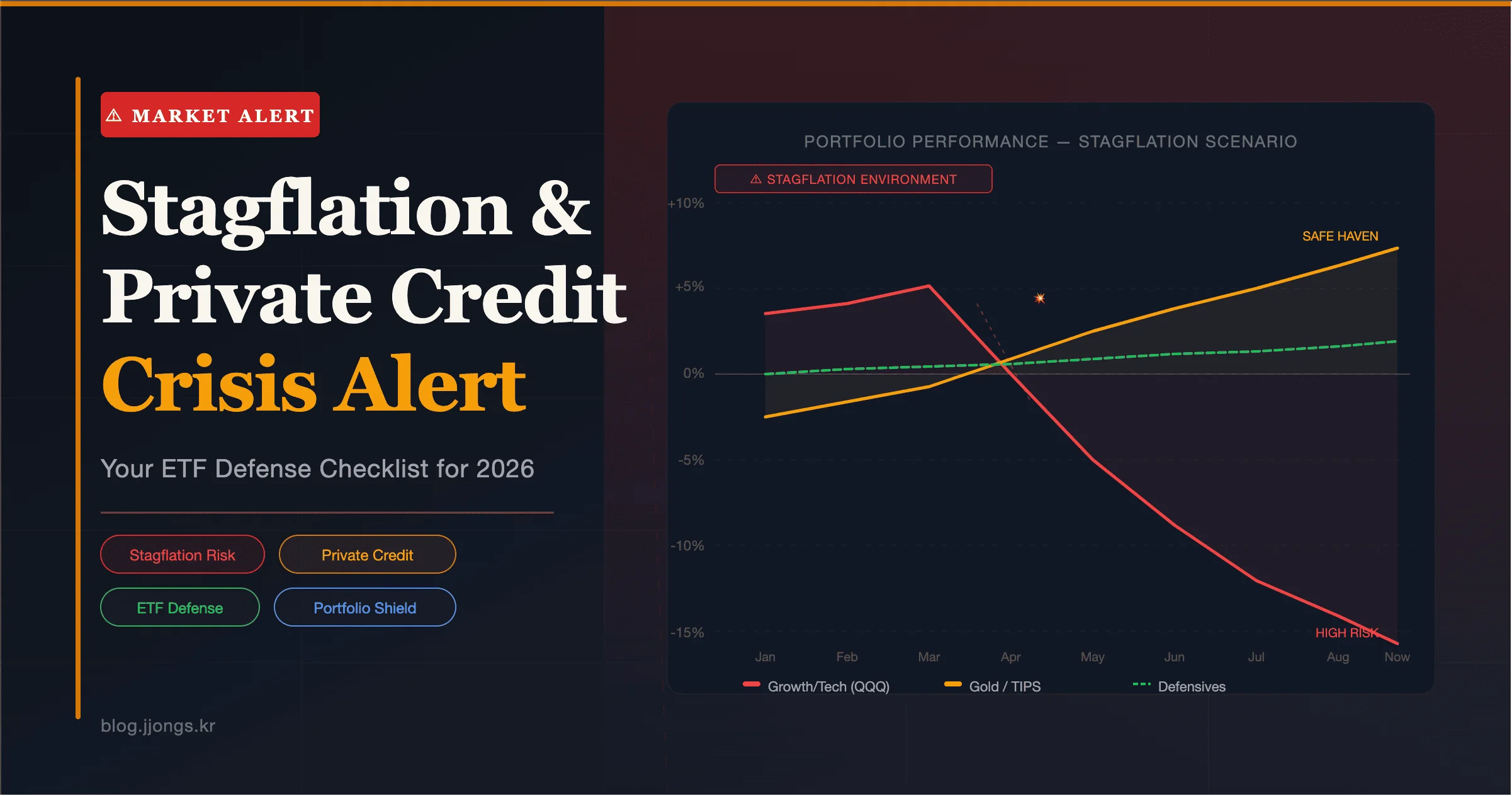
Market Alert — March 2026. Two slow-moving threats are converging on investor portfolios: a stagflation ETF defense gap that most retail investors have not yet closed, and a private credit market showing cracks that prominent Wall Street voices are comparing to the pre-2008 era. This post walks you through every ETF category that deserves a hard look right now, flags the specific tickers most exposed to these twin risks, and outlines the minimum defensive moves you can make today—without abandoning your long-term strategy.
If you hold a standard growth-tilted portfolio built during the 2020–2024 bull market, read carefully. The playbook that worked then is the opposite of what works in a stagflationary environment.
📋 Table of Contents
- What Stagflation Looks Like Right Now
- The Private Credit Time Bomb
- ETF Risk Checklist: Which Holdings to Scrutinize
- ETFs Most Vulnerable to Stagflation
- Minimum Defense: ETFs That Hold Up
- Your 5-Step ETF Defense Action Plan
- Bottom Line
1. What Stagflation Looks Like Right Now
Stagflation is the toxic combination of stagnant economic growth, persistent inflation, and rising unemployment—conditions that trap the Federal Reserve in a policy dilemma: cut rates to revive growth and risk re-accelerating inflation, or hold tight and let the economy stall. ETF Trends notes that stagflation scenarios tend to be worse for balanced portfolios than standard recessions, precisely because the Fed’s usual toolkit is neutralised.
In early 2026, the classic stagflation ingredients are largely in place. Tariff-driven cost-push inflation—stemming from sweeping reciprocal tariffs introduced in 2025—continues to push prices higher even as consumer spending cools. According to JPMorgan economists, tariff-driven stagflation expectations were a key factor behind downward GDP revisions toward 1.3% for 2025, and the growth picture has not brightened materially since. Meanwhile, the Federal Reserve—which began cutting rates in September 2025—faces the uncomfortable possibility that each rate cut could push still-elevated inflation even higher.
The one component that has historically been the definitive marker of stagflation—mass unemployment—has not fully materialised. But Barclays economists have estimated that job growth could slow to roughly 60,000 per month, dragging the growth rate toward 1.4–1.6%. At that pace, the labour market can shift from resilience to stress faster than most investors expect.
The 1970s Playbook Is Back on the Desk
Echoes of the 1970s are deliberate, not rhetorical. Then as now, the inflation was cost-push in nature—supply-side shocks rather than demand overheating—which made it far harder to subdue. The Fed’s eventual solution (hiking rates above 19% in 1981) was devastating for both bonds and growth stocks. Today’s Fed is nowhere near that territory, but the directional lesson matters: in a stagflationary environment, both traditional equities and long-duration bonds can fall simultaneously, eliminating the diversification benefit that most 60/40 portfolios rely on.
“Stagflation is the combination of economic STAGnation and inFLATION. While a much rarer occurrence—stagflation has only occurred once in the last century, during the 1970s and early 80s—this particular combination of economic factors creates a very difficult investing landscape.” — ETF Trends / ETF Strategist Channel
2. The Private Credit Time Bomb
The second threat to your ETF portfolio is less intuitive but potentially more explosive: a gathering stress event in the $3 trillion private credit market. Understanding this risk is critical for any investor holding financial sector ETFs, high-yield bond ETFs, or diversified credit funds.
How Big Is This Market?
According to Morgan Stanley data cited by the Irish Times, the private credit sector has grown from roughly $2 trillion in 2020 to $3 trillion by end-2025—and projections from CNBC suggest expansion toward $4.9 trillion by 2029. This staggering growth was fuelled by post-2008 banking regulations that pushed risky corporate lending off bank balance sheets and into non-bank lenders: private equity firms, business development companies (BDCs), and asset managers.
Warning Signs Already Flashing
The stress indicators have been accumulating since late 2025 and accelerated into early 2026:
- First Brands & Tricolor (late 2025): Two auto-sector borrowers collapsed under over-leveraged private credit structures, exposing what critics call “garbage loan” underwriting. JPMorgan CEO Jamie Dimon warned after these collapses: “When you see one cockroach, there are probably more.”
- Market Financial Solutions / MFS (February 2026): The London-based mortgage lender entered insolvency proceedings, with court filings citing serious irregularities, alleged asset double-pledging, and a collateral shortfall reportedly in the hundreds of millions. Barclays alone carried ~$800 million in exposure, according to The Daily Economy.
- Blue Owl fund gate (February 2026): One of the largest private credit firms gated withdrawals from a retail vehicle and sold assets to raise cash—a classic early-stage liquidity-crunch signal.
- BlackRock loan write-down: BlackRock slashed the carrying value of a $25 million private loan to zero at the end of 2025, having valued the same loan at 100 cents on the dollar just three months earlier.
- Blackstone redemptions: A Blackstone private credit fund raised its repurchase cap to meet nearly $2 billion in redemptions, highlighting how quickly redemption pressure can spread.
Sage Advisory’s enterprise research notes that Jeffrey Gundlach, CEO & CIO of DoubleLine Capital, has called private credit “the top candidate to start the next financial crisis,” and has specifically criticised semi-liquid private-credit ETFs as the “ultimate sin” for structural fragility. Bridgewater’s Ray Dalio has echoed concerns about mounting stress in venture capital and private credit markets due to higher rates squeezing leveraged private assets.
The Bank Exposure Problem
What makes this systemic rather than isolated is the banking sector’s indirect exposure. PYMNTS reports that JPMorgan disclosed approximately $160 billion in exposure to non-bank financial institutions in 2025—triple the $50 billion level in 2018. Across the entire US banking industry, total lending to these institutions reached approximately $1.57 trillion. If private credit stress intensifies and banks are forced to recognise losses on that lending, the contagion path into broader credit markets—and into ETFs that hold financial stocks or corporate bonds—becomes real.
⚠️ Investor Note: Goldman Sachs has warned that around 15% of private credit borrowers are no longer generating enough cash to fully cover interest payments, with many others operating with minimal margin. Source: CNBC, January 2026. This is a pre-stress indicator, not a current crisis—but the trajectory matters for ETF holdings in financial services.
3. ETF Risk Checklist: Which Holdings to Scrutinize
Before deciding which ETFs to reduce or add, run your current portfolio against this checklist. Each question corresponds to a meaningful risk exposure given the current stagflation ETF defense environment.
🔍 Checklist: Flag These If You Own Them
| ETF Category | Key Risk in Stagflation | Representative Tickers | Risk Level |
|---|---|---|---|
| Long-Duration Bond ETFs | Rising inflation erodes real value of fixed payments; rate hikes crush bond prices | TLT, EDV, ZROZ | 🔴 High |
| Growth / Tech ETFs | High P/E multiples compress when rates stay elevated; revenue growth slows with economy | QQQ, VGT, XLK, ARKK | 🔴 High |
| Financial Sector ETFs | Slowing loan demand; rising defaults; indirect private credit exposure; margin compression | XLF, KRE, IAT | 🟠 Elevated |
| Industrial ETFs | Tariff cost increases; weaker demand for goods and infrastructure in stagnant economy | XLI, IYT, PAVE | 🟠 Elevated |
| Consumer Discretionary ETFs | Household budgets squeezed by inflation; discretionary spending cut first in downturns | XLY, FDIS, VCR | 🟠 Elevated |
| High-Yield / Private Credit ETFs | Rising defaults; valuation opacity; potential liquidity mismatches; BDC write-downs | HYG, JNK, semi-liquid BDC ETFs | 🔴 High |
| Emerging Market ETFs | Strong USD pressure on EM currencies; slowing global trade dampens export-led EM growth | EEM, VWO, IEMG | 🟡 Moderate |
| Leveraged / Inverse ETFs | Daily rebalancing decay accelerates in high-volatility, range-bound stagflationary markets | TQQQ, SOXL, UPRO | 🔴 Very High |
Risk levels are directional guidance based on current macro conditions, not personalised investment advice. Review each position in the context of your full portfolio and time horizon.
4. ETFs Most Vulnerable to Stagflation: A Deeper Look
Technology ETFs: The Valuation Trap
The technology sector’s decade-long dominance was largely a function of falling interest rates compressing discount rates and inflating future earnings projections. In a stagflation ETF defense scenario, that tailwind reverses. ETF.com has listed QQQ and VGT among the worst-positioned sector ETFs for a stagflationary environment, noting that even though both showed resilience during the 2025 tariff-pause rally, “the underlying threat of tariff-related inflation and a slowing economy can still exert significant downward pressure on these sectors.”
The risk is compounding: technology companies that borrowed aggressively at low rates to fund buybacks and capital expenditures now face rising debt-service costs at exactly the moment when growth is slowing. ETFs like QQQ (which tracks the Nasdaq-100) and ARKK (active innovation) carry the heaviest exposure here.
Financial ETFs and the Private Credit Contagion Path
ETF.com specifically identifies XLF as facing a difficult environment in stagflation: stagnant growth dampens loan demand, while rising unemployment increases default risk. If private credit stress does transmit to bank balance sheets—through the $1.57 trillion in bank lending to non-bank financial institutions—financial sector ETFs could face a double headwind of deteriorating loan books and tighter net interest margins simultaneously.
Regional bank ETFs (KRE, IAT) deserve extra caution. Regional banks have less balance-sheet flexibility than money-centre giants and historically amplify financial stress rather than absorbing it.
Long-Duration Bonds: The Stagflation Nightmare
This point cannot be overstated. Meketa Investment Group’s stagflation primer states that “stagflation creates a punishing environment for most traditional asset classes” and that “fixed income investments fare little better” than equities in this environment—because inflation erodes the real value of fixed payments even as interest rate hikes depress bond prices. Long-duration Treasury ETFs like TLT (iShares 20+ Year Treasury Bond ETF) lost over 30% during the 2022 rate-hike cycle. Another cycle of persistent inflation could repeat that outcome.
Semi-Liquid Private Credit ETFs: The Structural Risk
A newer, less understood category deserves a flag: ETFs that blend private credit with public debt to offer daily liquidity over inherently illiquid underlying loans. Sage Advisory warns that these vehicles rely on public credit to backstop daily liquidity, creating “structural mismatch between equity-leg redemption cycles and illiquid underlying assets.” Similar vehicles—interval funds and non-traded BDCs—have already exhibited gating and NAV discontinuities under stress. Gundlach has explicitly called these products the “ultimate sin.”
5. Minimum Defense: ETFs That Hold Up in Stagflation
Building a stagflation ETF defense does not require dismantling your entire portfolio. The goal is to increase the share of holdings that are either inflation-resistant, economically non-cyclical, or both. Here are the best-supported categories, with key tickers for each.
Defensive Sector ETFs
ETF.com’s stagflation defense framework highlights three sectors that held up well during the Q1 2025 volatility spike and are likely to repeat that performance:
- Consumer Staples — XLP (Consumer Staples Select Sector SPDR Fund): Invests in household brands people continue to buy regardless of economic conditions—food, beverages, cleaning products. Demand is inelastic. XLP carries a modest expense ratio and pays a consistent dividend.
- Utilities — XLU (Utilities Select Sector SPDR Fund): Electric, gas, and water companies with regulated, predictable cash flows and reliable dividends. Utilities tend to outperform when growth slows and income-seeking investors rotate away from riskier assets.
- Health Care — XLV (Health Care Select Sector SPDR Fund): Pharmaceuticals, biotech, and healthcare services. Demand is structurally independent of the business cycle—people don’t stop needing medical care in a recession. XLV has been among the more consistent performers across stagflationary periods historically.
Gold ETFs: The Classic Inflation Hedge
Gold has delivered strong performance throughout 2025 and into 2026, breaking above the $4,000 level in early 2026. VanEck’s portfolio managers note that two durable forces support gold: central bank buying at record levels for three consecutive years as institutions diversify reserves away from the US dollar, and Western investment demand that has turned higher after years of absence.
Cost-effective access is available through:
- GLD — SPDR Gold Shares (largest gold ETF; highest liquidity)
- IAU — iShares Gold Trust (lower expense ratio than GLD)
- IAUM — iShares Gold Trust Micro (expense ratio of just 0.09%; excellent for cost-conscious long-term holders)
- SGOL — Aberdeen Physical Gold Shares ETF (physically backed; direct correlation to spot price)
TIPS ETFs: Inflation-Adjusted Income
Treasury Inflation-Protected Securities adjust their principal with changes in the Consumer Price Index, ensuring that rising inflation increases rather than erodes investor returns. State Street SPDR research highlights TIPS as one of the most direct hedges in a stagflationary environment.
Key options:
- SCHP — Schwab U.S. TIPS ETF (very low expense ratio; broad TIPS exposure)
- TIPS — iShares TIPS Bond ETF (the benchmark TIPS ETF by BlackRock)
- IVOL — Quadratic Interest Rate Volatility and Inflation Hedge ETF (actively managed; adds OTC options exposure to interest rate volatility; historically outperforms during fixed income stress periods)
Ultra-Short Treasury ETFs: Cash-Like Safety with Yield
ETF.com’s stagflation analysis notes that in 2025–2026, investors have strongly favoured ultra-short Treasury ETFs for their combination of higher yields and near-zero duration risk. Morningstar’s 2026 ETF predictions forecast continued strong inflows into these vehicles as US stock valuations remain stretched by historical standards.
- SGOV — iShares 0–3 Month Treasury Bond ETF (tracks ultra-short-term Treasurys; very high yield relative to price risk)
- BIL — SPDR Bloomberg 1–3 Month T-Bill ETF (similar profile; slightly lower duration)
- GOVT — iShares U.S. Treasury Bond ETF (broader maturity exposure; expense ratio of just 0.05%; 30-day SEC yield approximately 3.84%)
Energy ETFs: Historical Stagflation Outperformers
Energy companies have historically delivered strong returns in inflationary environments because their revenues rise with energy prices even as operating costs remain relatively fixed. U.S. News quotes James Mick of Tortoise Capital: “Traditionally, energy companies have done well during inflationary environments.” A note of caution: slowing global growth can reduce energy demand, so energy is a hedge against the inflation component of stagflation, not the stagnation component.
- VDE — Vanguard Energy ETF (low-cost; major positions in Exxon, Chevron, ConocoPhillips)
- XLE — Energy Select Sector SPDR Fund (most liquid energy ETF; S&P 500 energy sector)
International Diversification
European equity ETFs outperformed US stocks in 2025 as investors sought relative stability amid escalating US trade tensions and a weaker US economic outlook. The geographic diversification away from US macro risk has become a meaningful portfolio consideration.
- EFA — iShares MSCI EAFE ETF (broad developed international markets ex-US and Canada)
- VEA — Vanguard FTSE Developed Markets ETF (similar exposure; lower cost)
Value ETFs: Fundamentals Over Momentum
Growth stocks command premium valuations that compress when rates stay high. Value ETFs—focusing on companies trading below intrinsic value with strong cash flows and dividends—historically fare better in both inflationary and stagnant economic periods. Zacks Investment Research recommends VTV (Vanguard Value ETF), IWD (iShares Russell 1000 Value), and IVE (iShares S&P 500 Value) as the top value-oriented stagflation defense options.
6. Your 5-Step ETF Defense Action Plan
Knowing which ETFs are vulnerable and which are resilient is the analysis. Now comes the execution. Here is a practical, five-step stagflation ETF defense protocol you can implement without making rash all-in-or-all-out decisions.
Step 1: Audit Your Duration Exposure First
The single highest-urgency action is reviewing your bond ETF holdings for average duration. Any holding with an average duration above seven years is significantly exposed to persistent inflation. Check the fund’s fact sheet for “Effective Duration”—a number above 7 years in a stagflationary environment is a liability, not a diversifier. Consider trimming or rotating to shorter-duration equivalents (SGOV, BIL, or short-term corporate bond ETFs).
Step 2: Reduce Concentration in Pure Growth
If tech and growth ETFs represent more than 30% of your equity exposure, consider a gradual trim toward the 15–20% range and redirect those proceeds into defensive sectors (XLP, XLU, XLV) or value ETFs (VTV, IWD). This does not mean abandoning growth entirely—it means ensuring that a prolonged period of high rates and slow growth does not devastate your portfolio before recovery arrives.
Use dollar-cost averaging on the way out, not panic selling. A systematic 5–10% monthly reduction in overweight growth positions is less emotionally disruptive and often produces better tax outcomes than a single large sale.
Step 3: Build a Minimum Inflation Hedge (TIPS + Gold)
A combined allocation of 5–10% to inflation-linked assets is widely recommended as a minimum hedge in stagflationary conditions. For most retail investors, the simplest implementation is:
- 3–5% into a TIPS ETF (SCHP or TIPS) for direct inflation linkage on the fixed income side
- 3–5% into a gold ETF (IAU or IAUM) for real asset protection and safe-haven properties
This allocation is not designed to generate spectacular returns—it is designed to ensure that at least a portion of your portfolio is moving in the opposite direction to your growth holdings during a stagflationary episode.
Step 4: Stress-Test Your Financials Exposure Against Private Credit Risk
If you hold XLF, KRE, or broad financial sector ETFs, take twenty minutes to look at the underlying holdings. How much exposure is there to banks that have significant non-bank lending relationships? Regional bank ETFs in particular are worth scrutinising, given that institutions with up to $100 billion in assets hold nearly $38 billion in private equity lending alone. The private credit contagion is not assured, but the risk/reward of heavy financials exposure is less attractive in the current environment than it was in 2023 or 2024.
Step 5: Keep a Cash Buffer—and Park It Intelligently
The final element of stagflation ETF defense is maintaining enough liquidity to avoid being forced to sell long-term positions at the wrong time. A 5–15% allocation to ultra-short Treasury ETFs (SGOV or BIL) accomplishes three things simultaneously: it provides income (currently yielding meaningfully above zero), it preserves capital if markets deteriorate, and it gives you dry powder to deploy when defensive ETFs or value positions become attractively priced during a market dislocation.
A “cockroach portfolio” concept gaining traction in early 2026 proposes equal allocations across US equities, international equities, long-term bonds, gold, and commodities—rebalanced quarterly—as a structural approach to surviving multiple economic scenarios including stagflation. After the 2008 crash, this portfolio type recovered in roughly two years compared to over four years for a pure S&P 500 approach, and delivered a higher Sharpe ratio (0.72 versus 0.45) over the measured period. It is worth benchmarking your own portfolio against this concept.
7. Bottom Line
The convergence of stagflation risk and private credit stress in early 2026 is not a prediction of imminent collapse—it is a signal that the risk profile of standard growth portfolios has changed materially from what it was two or three years ago. The tools to respond are straightforward: reduce duration in bonds, moderate tech and growth concentration, add real inflation hedges (TIPS, gold), favour defensive sectors (staples, utilities, healthcare), and maintain intelligent liquidity.
The investors most at risk right now are not those who are fully invested—they are those who are fully invested in the wrong kind of assets for this environment. A thoughtful stagflation ETF defense does not require abandoning long-term investing principles. It requires updating the portfolio map to reflect the terrain that actually lies ahead.
✅ Quick Reference: Stagflation ETF Defense Summary
Reduce exposure to: TLT / long-duration bonds, QQQ / VGT / growth tech, HYG / JNK / semi-liquid private credit, XLF / KRE financial sector
Consider building / maintaining: XLP / XLU / XLV defensive sectors, SCHP / TIPS inflation-linked bonds, GLD / IAU / IAUM gold, SGOV / BIL ultra-short Treasurys, VTV / IWD value equities, VDE / XLE energy, EFA / VEA international diversification
This post is for informational and educational purposes only. Nothing here constitutes personalised investment advice. Always consult a qualified financial advisor before making changes to your portfolio. Past performance of any ETF or asset class is not a guarantee of future results.
Related reading:
- How to Read an ETF Fact Sheet: Complete Guide to Performance, Fees & Risk Analysis
- Tech ETF Comparison: QQQ vs VGT vs XLK vs FTEC
⚠️ Disclaimer: I am not a licensed financial advisor. Content here is for educational purposes only and should not be considered personalized investment advice. Always do your own research before making investment decisions.