Tech ETF Comparison: QQQ vs VGT vs XLK vs FTEC – Which One Actually Wins?
Looking for the best tech ETF comparison for 2026? If you’re trying to choose between QQQ, VGT, XLK, and FTEC, you’re not alone. These four tech ETFs dominate investor portfolios, but here’s the problem: they’re not the same at all.
This comprehensive tech ETF comparison will show you exactly which one deserves your money. I spent hours analyzing performance data, expense ratios, holdings, and risk metrics so you don’t have to.
The Quick Answer (If You’re Busy)
In this tech ETF comparison, here’s what we found:
For most investors: VGT or FTEC give you the purest, broadest tech exposure.
For diversified growth: QQQ includes tech plus other high-growth sectors.
For concentrated mega-cap exposure: XLK focuses on the biggest tech names from the S&P 500.
Still here? Good. Let’s dive into the details that actually matter.
Tech ETF Comparison: The Four Contenders Explained
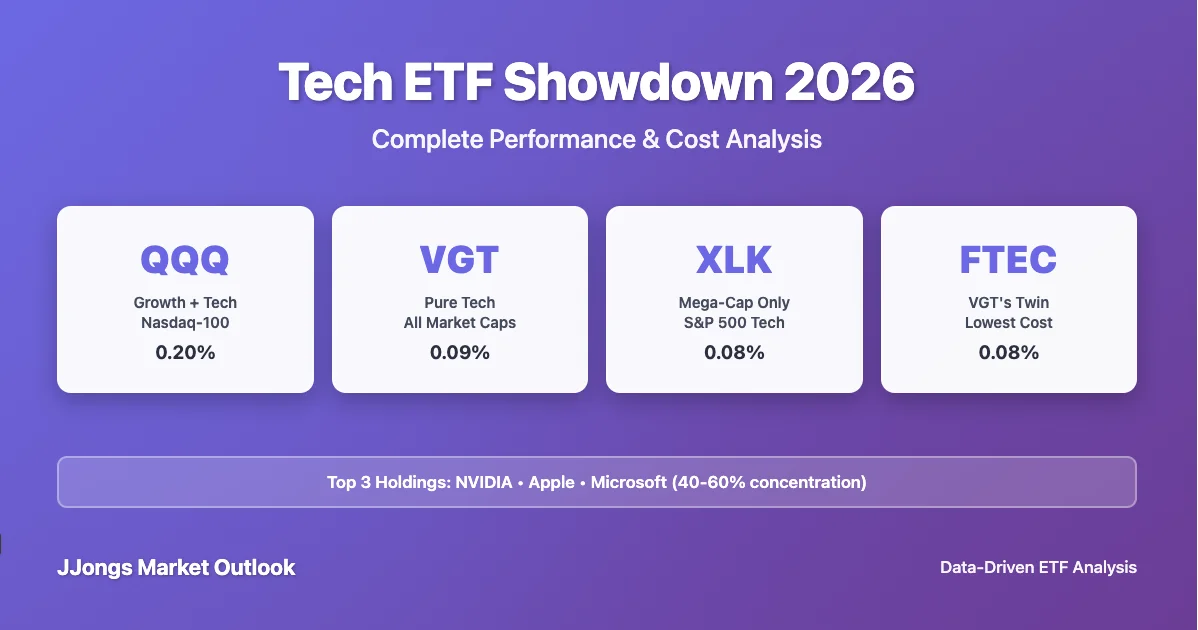
QQQ (Invesco QQQ Trust)
- What it tracks: Nasdaq-100 Index (top 100 non-financial companies on Nasdaq)
- Tech allocation: ~55-65% (the rest is consumer discretionary, communications, etc.)
- Number of holdings: 102 companies
- Expense ratio: 0.20%
- Assets under management: ~$383 billion
- Inception: March 10, 1999
The reality: QQQ isn’t a pure tech ETF. It’s a growth ETF that happens to be tech-heavy. You’re getting Apple, Microsoft, and Nvidia, but you’re also getting Tesla, Amazon, Costco, and Starbucks.
VGT (Vanguard Information Technology ETF)
- What it tracks: MSCI US Investable Market Information Technology 25/50 Index
- Tech allocation: ~98-100%
- Number of holdings: 314-319 companies
- Expense ratio: 0.09%
- Assets under management: ~$90+ billion
- Inception: January 26, 2004
The reality: This is pure tech. From mega-caps to small-caps, if it’s in the information technology sector, VGT probably owns it.
XLK (Technology Select Sector SPDR Fund)
- What it tracks: S&P Technology Select Sector Index
- Tech allocation: ~99-100%
- Number of holdings: 68-71 companies
- Expense ratio: 0.08%
- Assets under management: ~$89-92 billion
- Inception: December 16, 1998
The reality: XLK only picks from S&P 500 tech stocks. It’s concentrated, focused, and sticks to the giants. If you want exposure to mid or small-cap tech, look elsewhere.
FTEC (Fidelity MSCI Information Technology Index ETF)
- What it tracks: MSCI USA IMI Information Technology 25/50 Index
- Tech allocation: ~98-100%
- Number of holdings: 284-300+ companies
- Expense ratio: 0.08%
- Assets under management: ~$16-17 billion
- Inception: October 21, 2013
The reality: FTEC is VGT’s cheaper cousin. Nearly identical holdings and strategy, but with a lower expense ratio and smaller asset base.
The Numbers That Actually Matter
Performance (As of Late 2025)
Year-to-date (2025):
- XLK: +17.59%
- VGT: +15.51%
- QQQ: ~18%
- FTEC: ~14%
1-Year Returns:
- XLK: +18.39%
- VGT: +17.46%
- QQQ: Similar to XLK
- FTEC: Slightly behind VGT
5-Year Returns:
- QQQ: ~102%
- XLK: ~128%
- VGT: ~121%
- FTEC: Similar to VGT
10-Year Annualized Returns:
- VGT: 21.62%
- XLK: 21.42%
- QQQ: ~19%
- FTEC: N/A (launched in 2013)
The takeaway: Performance differences are smaller than you’d think. Over the long run, VGT and XLK are neck-and-neck, with QQQ trailing slightly due to its non-tech holdings.
Top Holdings: The Real Story
Here’s where things get interesting. All four ETFs are dominated by the same three companies:
Top 3 Holdings (Approximate % of Fund):
| Stock | QQQ | VGT | XLK | FTEC |
|---|---|---|---|---|
| NVIDIA | 8.9% | ~15% | ~13% | ~15% |
| Apple | 7.3% | ~14% | ~13% | ~14% |
| Microsoft | 6.1% | ~13% | ~12% | ~13% |
| Top 3 Total | ~22% | ~42% | ~38% | ~42% |
Top 10 Holdings:
- QQQ: ~54% of total assets
- VGT: ~60% of total assets
- XLK: ~62% of total assets
- FTEC: Similar to VGT
What this means: VGT, XLK, and FTEC are heavily concentrated in mega-cap tech. QQQ is more balanced because it includes non-tech stocks.
If Nvidia, Apple, or Microsoft stumble, VGT/XLK/FTEC will feel it harder than QQQ.
The Critical Differences Nobody Talks About
1. Sector Classification Matters (A Lot)
Here’s something most investors don’t know: QQQ includes “tech companies” that VGT, XLK, and FTEC can’t touch.
Why? Because of how sectors are defined.
Companies QQQ owns that pure tech ETFs don’t:
- Meta (Facebook): Classified as “Communication Services”
- Alphabet (Google): Communication Services
- Amazon: Consumer Discretionary
- Tesla: Consumer Discretionary
These are tech companies in everything but their official sector classification. QQQ holds them; VGT/XLK/FTEC don’t.
Is this good or bad?
Good: You get exposure to tech-driven companies regardless of their label.
Bad: You’re not getting “pure” tech exposure if that’s what you wanted.
2. Market Cap Exposure
XLK: 99.5% large-cap, 0.4% mid-cap, 0% small-cap
- This is mega-cap only. Period.
VGT: 88% large-cap, 10% mid-cap, 2% small-cap
- Broader exposure across the market cap spectrum.
FTEC: 89% large-cap, 9% mid-cap, 2% small-cap, 0.1% micro-cap
- Nearly identical to VGT.
QQQ: Primarily large-cap with some mid-cap exposure
- Focused on the biggest companies across sectors.
What this means:
- Want to capture the next big tech mid-cap before it becomes a giant? VGT or FTEC.
- Only care about the mega-caps that already dominate? XLK.
- Want the biggest growth names regardless of sector? QQQ.
3. Cost: The Long-Term Killer
Let’s talk about what these fees actually cost you.
Expense Ratios:
- QQQ: 0.20%
- VGT: 0.09%
- XLK: 0.08%
- FTEC: 0.08%
Real-world math: On a $10,000 investment:
- QQQ: $20/year
- VGT: $9/year
- XLK: $8/year
- FTEC: $8/year
The difference seems tiny, but compound it over 20 years at 10% annual returns:
$500/month invested over 20 years:
- FTEC/XLK (0.08%): ~$380,000
- VGT (0.09%): ~$379,500
- QQQ (0.20%): ~$375,800
You’d pay $4,200+ more in fees with QQQ. That’s real money.
4. Volatility and Risk
Beta (compared to S&P 500):
- QQQ: 1.27
- VGT: 1.52
- XLK: 1.50
- FTEC: Similar to VGT
Higher beta = more volatile. Tech ETFs move faster than the market in both directions.
Maximum Drawdown (2020-2022 period):
- VGT: -54.63%
- XLK: -82.05%
XLK got hit harder during downturns because of its concentrated portfolio.
5. Dividend Yield (Don’t Get Excited)
None of these are dividend powerhouses:
- QQQ: 0.47%
- VGT: 0.41%
- XLK: 0.54%
- FTEC: Similar to VGT
Tech stocks reinvest in growth, not dividends. If you want income, look at dividend-focused ETFs instead.
Tech ETF Comparison Verdict: Which One to Buy?
Buy QQQ If:
- You want diversified growth exposure, not just tech
- You like having Meta, Amazon, and Tesla in the mix
- You’re okay paying 0.20% for a fund that includes the best growth companies across sectors
- You value the Nasdaq-100 brand and massive liquidity
Best for: Growth investors who want tech-heavy exposure without going 100% tech.
Buy VGT If:
- You want pure tech exposure across all market caps
- You believe in mid-cap and small-cap tech upside
- You want 314+ holdings for diversification within tech
- You trust Vanguard’s track record
Best for: Tech believers who want broad sector coverage at a reasonable cost.
Buy XLK If:
- You only want mega-cap tech from the S&P 500
- You prefer a concentrated portfolio (71 holdings)
- You’re willing to accept higher volatility for potentially higher returns
- You want the absolute lowest expense ratio
Best for: Investors confident in big tech dominance who don’t care about mid/small caps.
Buy FTEC If:
- You want VGT’s strategy at XLK’s price
- You don’t care about lower assets under management
- You’re a Fidelity customer (easier integration)
- You want the best cost-to-diversification ratio
Best for: Cost-conscious investors who want broad tech exposure.
The Verdict: Here’s What I’d Do
If I had to pick one: VGT or FTEC.
Why? They give you complete tech sector coverage at rock-bottom costs. The 0.08-0.09% expense ratio is negligible, you get 300+ holdings, and you’re not missing out on mid-cap tech opportunities.
Between VGT and FTEC: Flip a coin. They’re 95% identical. VGT has more assets and a longer track record. FTEC is $1/year cheaper on $10,000 invested.
What about QQQ? Great fund, but it’s not a tech ETF. It’s a growth ETF. If you want diversified growth exposure, QQQ is excellent. But if you specifically want tech, the pure plays (VGT/XLK/FTEC) make more sense.
What about XLK? Only if you’re absolutely certain that the mega-cap tech dominance continues. The concentration risk is real, and the 2020-2022 drawdown proved it.
The Hidden Risk Nobody Mentions
All four ETFs have the same problem: concentration risk.
When 40-60% of your fund is in the top 10 holdings, and the top 3 are always Nvidia, Apple, and Microsoft, you’re not as diversified as you think.
If those three companies hit a rough patch, all four ETFs will suffer. The question is: how much?
- QQQ: Better protected because of non-tech diversification
- VGT/FTEC: Moderate risk with 300+ holdings providing some cushion
- XLK: Highest risk with only 71 holdings
Final Thoughts
The “best” tech ETF depends on what you’re actually trying to accomplish.
Want pure tech? VGT or FTEC.
Want diversified growth with a tech tilt? QQQ.
Want concentrated mega-cap tech? XLK.
The performance differences over 10+ years are surprisingly small. What matters more is:
- Your risk tolerance (can you stomach 50%+ drawdowns?)
- Your belief in sector vs. growth investing
- Your preference for concentration vs. diversification
Personally, I’d split the difference: 60% VGT/FTEC for broad tech exposure, 40% QQQ for diversified growth. But that’s me.
What matters is that you understand what you’re buying and why.
⚠️ Disclaimer: I am not a licensed financial advisor. Content here is for educational purposes only and should not be considered personalized investment advice. Always do your own research before making investment decisions.